

How to Choose Safe Pet Toys: A 2026 Guide
Table of Contents
- Start with Size and Breed: The First Safety Filter
- Match Toy Type to Play Style and Temperament
- Safest Dog Toy Materials: What to Look For and Avoid
- Identify and Prevent Pet Toy Choking Hazards
- Your Dog Toy Safety Checklist: Inspect, Supervise, Replace
- How Often to Replace Dog Toys: A Simple Schedule
- What to Do After a Toy-Related Incident
- Conclusion
- Frequently Asked Questions
Last Updated: October 12, 2026
Start with Size and Breed: The First Safety Filter
Learning how to choose safe pet toys starts with one question: can your pet fit this in their mouth?
Size comes first, and it is about your pet's mouth, not the package label.
Here is how to size a toy correctly:
- Pick toys wider than your pet's throat opening
- Check the muzzle size, not just the breed
- Watch your pet's jaw width when they open wide
- Skip anything that fits fully behind the teeth
Breed matters too, but not the way most people think. A small terrier with a strong jaw can destroy a toy built for a much larger dog.
Match Toy Type to Play Style and Temperament
The best toy matches how your pet actually plays. Ignore the toy aisle and watch your pet for five minutes instead.
Most pets fall into one of these play styles:
| Play Style | Best Toy Type | What to Avoid |
|---|---|---|
| Chewer | Hard rubber, nylon | Plush, rope |
| Chaser | Interactive, active toys | Stationary comfort toys |
| Tugger | Rope, flexible rubber | Small hard parts |
| Cuddler | Plush, comfort toys | Hard chews |
| Forager | Treat-dispensing, food-stuffable | Simple squeakers |
Active toys keep high-energy pets moving. Comfort toys help anxious pets settle. Interactive toys bridge the gap for pets left alone.
A rescue dog with anxiety may destroy a plush toy in minutes but settle with a food-stuffable toy for an hour.
Safest Dog Toy Materials: What to Look For and Avoid
Material choice is where most toy injuries start.
What "non-toxic" actually means
No single federal standard certifies a pet toy as "non-toxic." The FDA regulates pet food and some animal drugs, but pet toys are not pre-approved like children's toys under Consumer Product Safety Commission rules, so a manufacturer can print "non-toxic" without proving it against a published test. What you can rely on instead:
- Material disclosures, a maker that names the polymer (for example, "medical-grade silicone" or "natural rubber") gives you something to verify. "Safe material" with no chemistry does not.
- Third-party testing claims, look for specific test names or standards rather than a badge. A vague "lab tested" seal means little; a named standard you can look up means more.
- Children's-toy standards as a proxy, some makers voluntarily test to children's toy safety rules, which restrict heavy metals and certain phthalates. That is meaningful because the testing is defined, even though it was written for kids, not pets.
Materials worth choosing
- Hard rubber that bounces back after a bite, natural rubber compounds flex and recover rather than crack
- Nylon rated for aggressive chewers, dense and non-splintering, but hard enough to wear enamel if used daily
- Rope made from undyed natural fibers, cotton or hemp, so you can see when fibers fray
- Food-grade silicone for treat toys, flexible, heat-stable, and free of the plasticizers that make cheap vinyl soft
- Non-toxic plush with securely stitched seams, the stitching and absence of glued-on parts matter more than the fabric
Materials and features to avoid

- Thin plastic that cracks into shards
- Painted toys with peeling coatings, paint is the most common source of lead and heavy-metal exposure in cheap imports
- Natural bone and antler pieces that can splinter; cooked bone is especially prone to fragmenting
- Toys with glued-on eyes, bells, or small parts
- Vinyl and soft PVC, which often contain phthalates used as plasticizers
The FDA guidance on pet product safety explains how the agency reviews pet products and what warning signs to watch for on labels.
Hardness is the number most owners miss
A toy harder than your pet's teeth will wear down enamel over time, a mechanical problem that shows up years later as worn or fractured teeth.
Match the material to the failure mode you are trying to prevent
Different materials fail differently, and the failure mode matters more than the durability claim:
| Material | Common failure | Risk it creates |
|---|---|---|
| Thin plastic | Cracks into shards | Cuts mouth, swallowed fragments |
| Plush | Seams split, stuffing out | Swallowed squeaker, blockage |
| Rope | Fibers unravel | Long strands swallowed, entanglement |
| Hard nylon | Wears enamel | Tooth damage over time |
| Natural rubber | Chunks torn off | Choking on pieces |
Choosing a material is choosing which risk to manage.
Identify and Prevent Pet Toy Choking Hazards
Pet toy choking hazards hide in plain sight. Most are not the toy itself but the pieces that break off it.
The top culprits:
- Squeakers that come loose inside plush toys
- Rope fibers that unravel into long strands
- Rubber chunks torn from a worn ball
- Buttons, ribbons, and glued decorations
- Batteries in electronic toys
Any of these can lodge in the throat or travel into the gut; intestinal blockage is the most dangerous outcome and often needs surgery.
Squeakers deserve special attention: they are the first part to fail in most plush toys, and exactly the size that slips past the teeth.
Your Dog Toy Safety Checklist: Inspect, Supervise, Replace
A dog toy safety checklist turns vague worry into a repeatable habit.
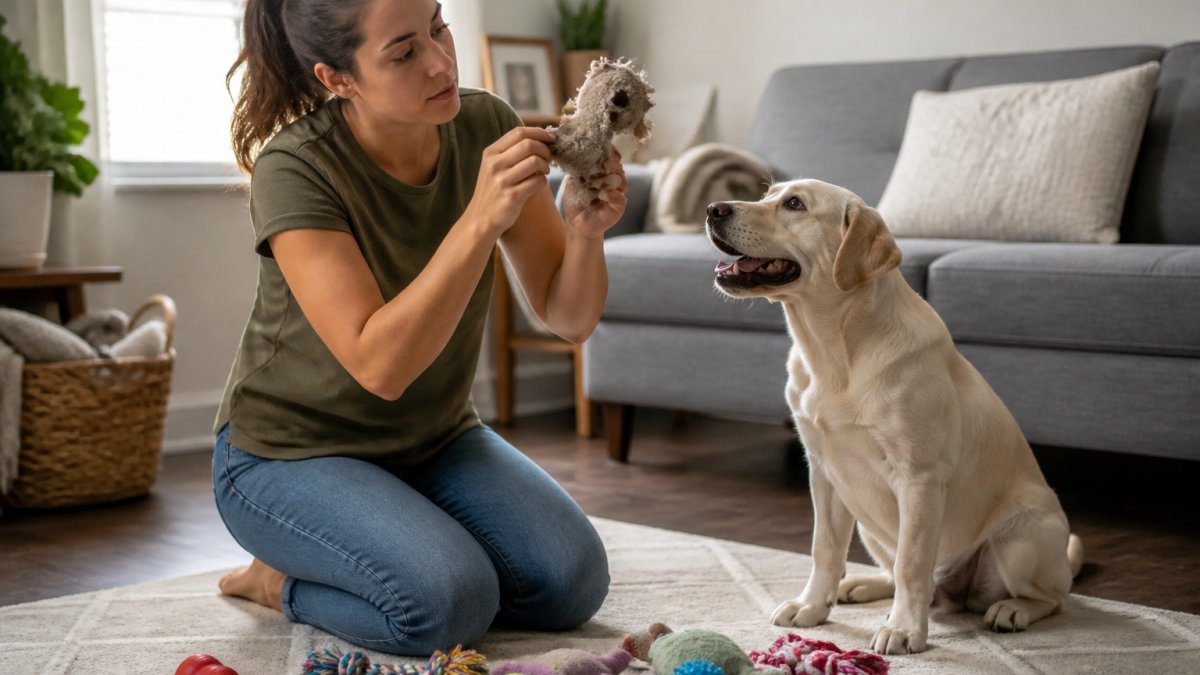
The inspection checklist
Tough Chew Rubber Toy for Aggressive Chewers →
- Squeeze the toy and listen for loose squeakers, one that moves freely inside is one bite from being swallowed
- Check seams for split stitching or exposed stuffing, exposed filling means the toy is one tug from coming apart
- Run a hand over the surface for cracks, sharp edges, or rough patches
- Tug on ropes to test for unraveling fibers, if strands pull loose, the toy is done
- Look for missing parts, including eyes, bells, and glued decorations
- Confirm the toy still fits your pet's size range, a toy safe for a puppy may be too small for the adult
What each failure point actually signals
- Loose squeaker: the internal bladder has separated from the shell, the most common cause of plush-toy blockage.
- Split seam: stitching has failed at a stress point. Once one seam goes, the rest follow quickly.
- Exposed stuffing: the outer layer is compromised; ingested filling can clump and obstruct.
- Fraying rope: fibers separate into long strands that can wrap around the tongue or be swallowed.
- Cracked rubber or plastic: the material has lost elasticity and will break into chunks rather than flex.
- Missing parts: anything small enough to disappear is small enough to swallow.
Supervision rules that actually reduce risk
Supervised play is the second half of the checklist. Most toy injuries happen when a pet is alone with a damaged toy.
- Keep high-risk toys, plush with squeakers, rope, anything with small parts, for supervised play only
- Leave only durable, single-piece toys in the crate or alone-time rotation
- Separate pets during chew sessions if one is a resource guarder
- Remove the toy the moment play shifts from chewing to tearing
Species differences matter
A dog checklist does not transfer cleanly to cats or small pets:
- Cats: string, ribbon, and yarn are the leading toy-related hazards because they can wrap around the tongue or be swallowed and cause linear obstruction. Cat toys should have no loose string longer than a few inches, and wand toys should be put away after play.
- Small pets (rabbits, guinea pigs, hamsters): chew toys must be free of wire, staples, and painted surfaces; small pieces a dog would ignore can block a small pet's gut.
- Birds: avoid toys with lead weights, zinc hardware, or frayed rope that can entangle toes.
Replacement triggers, not just a schedule
Any toy, regardless of age, gets retired the moment it shows damage. Worn toys are not a bargain, they are a hazard with a familiar smell. Use these triggers rather than a calendar date:
- Replace plush when any seam splits or stuffing appears
- Replace rope when strands pull free or the knot loosens
- Replace rubber when it cracks, tears, or loses its bounce
- Replace treat toys when the openings crack or the material softens
- Replace electronic toys when the casing cracks or the battery compartment opens
If something is swallowed
Do not wait to see if it passes. The ASPCA Animal Poison Control Center is a useful resource if you are unsure whether a swallowed material is toxic.
How Often to Replace Dog Toys: A Simple Schedule
Knowing how often to replace dog toys depends on material and play intensity, not the calendar: a plush toy may last a week, a hard rubber toy a year.
Use this schedule as a starting point:
- Plush toys: replace every 2 to 4 weeks
- Rope toys: replace every 1 to 2 months
- Hard rubber chews: replace every 6 to 12 months
- Treat-dispensing toys: replace every 3 to 6 months
- Electronic toys: replace when the casing cracks or the charge stops holding
Any toy, regardless of age, gets retired the moment it shows damage. Worn toys are not a bargain. They are a hazard with a familiar smell.
For heavy chewers, the timeline shrinks fast. Our Tough Chew Rubber Toy for Aggressive Chewers is built from ultra-durable non-toxic rubber that holds up to the strongest jaws, so it stays in rotation longer than a plush or rope option.
What to Do After a Toy-Related Incident
If your pet swallows part of a toy, act fast. Do not wait to see if it passes on its own.
Steps to take:
- Remove the toy and any matching pieces from reach
- Note what was swallowed, how much, and when
- Call your vet or an emergency clinic right away
- Watch for vomiting, drooling, gagging, or belly pain
- Follow your vet's guidance on monitoring or imaging
The ASPCA Animal Poison Control Center is a useful resource if you are unsure whether a swallowed material is toxic.
Keep the damaged toy as a reference. Your vet may want to see the material and size.
Conclusion
Picking safe pet toys comes down to three habits: size the toy to your pet, match it to how they play, and inspect it often.
At Furbabies4less, we select vet-informed toys designed to hold up, from our Interactive Dog Ball Toy for high-energy chasers to our Interactive Lick Ball for anxious pets who need calm enrichment.


Shop with Furbabies4less and give your pet toys you can trust.
Frequently Asked Questions
What is the 20 toy rule?
The 20 toy rule is a guideline suggesting you should have about 20 toys for your dog, rotated regularly. This provides variety for mental stimulation and physical activity while reducing boredom. It also allows you to inspect toys for wear and tear before they become dangerous. Rotating toys every few days keeps them novel and exciting, which is especially helpful for dogs with anxiety or destructive chewing habits. Always ensure each toy is appropriate for your dog's size, breed, and chewing style.
How do I check if a pet toy is safe?
Start by checking the toy's size: it should be too large to swallow and have no small parts that can break off. Look for non-toxic materials and sturdy construction. Inspect for loose squeakers, exposed seams, or sharp edges. Squeeze the toy to see if it deforms easily. For rope toys, ensure knots are tight and fibers aren't fraying. Supervise your pet's first interactions and remove the toy if any damage occurs. A dog toy safety checklist can help you evaluate new and existing toys regularly.
How often should you replace pet toys?
Replace pet toys every 1-3 months for aggressive chewers, or every 3-6 months for gentle players. Inspect toys weekly for signs of wear: cracks, missing pieces, frayed ropes, or exposed squeakers. Replace immediately if you notice damage. Even durable toys like hard rubber can degrade over time. Keeping a rotation and a replacement schedule prevents accidents. If your dog destroys toys quickly, consider tougher options like the Tough Chew Rubber Toy for Aggressive Chewers.
Are rope toys safe for dogs?
Rope toys can be safe if used with supervision. They are great for interactive play like tug, but they can fray and become a choking hazard if ingested. Avoid rope toys for dogs that tend to swallow strings, as this can cause intestinal blockage. Always check for loose threads and discard the toy if it starts to unravel. For cats, rope toys should be avoided unless they are part of a supervised wand toy, as cats may ingest fibers.
