

How to Calm Rescue Dog Anxiety: A Step-by-Step Guide
Table of Contents
- What Rescue Dog Anxiety Looks Like and Why It Happens
- The 3-3-3 Rule for Rescue Dogs: A Timeline for Settling In
- Setting Up a Safe Space and Predictable Routine
- Signs of Separation Anxiety in Dogs and How to Manage Them
- Using Calming Enrichment Toys for Dogs to Reduce Stress
- Desensitization, Counterconditioning, and Positive Reinforcement Training
- When to Consider Medication vs. Behavioral Modification
- Taking Care of Yourself While Helping Your Rescue Dog
- Frequently Asked Questions
Last Updated: September 13, 2026
What Rescue Dog Anxiety Looks Like and Why It Happens
Rescue dog anxiety is a stress response triggered by past trauma, sudden environmental change, or the loss of a familiar routine, and it shows up as pacing, hiding, destructive chewing, or refusing to eat. At Furbabies4less, we've seen how quickly fear-based behavior can surface once a dog leaves the shelter and enters a home. A tucked tail, flattened ears, and constant lip-licking are all calming signals that mean your dog is overwhelmed, not stubborn.
The first week is often the hardest. Everything a rescue dog knew, from the kennel sounds to the feeding schedule, disappears overnight. That sudden loss of predictability is what drives most early anxiety, and it's why patience matters more than training tricks in those first days.
Common Triggers for Hoarding and Abuse Survivors
Dogs rescued from hoarding situations often react to crowding, loud noises, or being approached head-on. Survivors of abuse may flinch at raised hands, sudden movements, or the sound of a heavy object dropping. These triggers are real and specific, so a generic "just be gentle" approach rarely works. Watch what happens right before your dog shuts down, and you'll usually find the trigger hiding in plain sight.
The 3-3-3 Rule for Rescue Dogs: A Timeline for Settling In
The 3-3-3 rule for rescue dogs breaks the settling-in process into three stages: three days to decompress, three weeks to learn your routine, and three months to feel fully at home (aspca.org). This timeline gives new owners realistic expectations instead of panic when a dog hides under the bed on day two.
In the first three days, most dogs are shut down or overly clingy. By three weeks, personality starts to emerge and small training wins become possible. Around three months, many dogs finally relax enough to show their true temperament. Knowing this rhythm helps you avoid pushing too fast.
Setting Up a Safe Space and Predictable Routine
A safe space is a quiet, low-traffic spot where your dog can retreat without being bothered, ideally a crate with the door left open or a corner with a soft bed. Pair it with a predictable routine: same feeding times, same walk windows, same bedtime. Predictability is what lowers a dog's baseline stress, because the brain stops scanning for threats when it knows what's coming next.
Keep the environment low-pressure. Avoid direct eye contact, let your dog approach you first, and skip the urge to introduce ten new people in week one. Consistent boundaries, like no furniture access until your dog settles, actually reduce anxiety rather than increase it.
Signs of Separation Anxiety in Dogs and How to Manage Them
Signs of separation anxiety in dogs include destructive chewing, nonstop barking, house soiling, and frantic attempts to escape within minutes of your departure (avma.org). These behaviors happen only when you're gone, which is what separates true separation anxiety from general boredom. The timing matters: a dog who starts pacing the moment your keys jingle is showing classic pre-departure anxiety, while a dog who destroys a pillow six hours in is more likely bored or under-exercised.
Before you assume separation anxiety, rule out the look-alikes. Isolation distress is a milder cousin, the dog is unhappy alone but can settle if another person or pet is present. Boredom shows up as destructive behavior regardless of whether you're home. Confinement anxiety is specific to the crate. Each has a different fix, and treating boredom with separation-anxiety protocols wastes weeks.
A Graded Absence Protocol That Actually Works
The core of separation anxiety training is systematic desensitization to your departure cues, paired with counterconditioning. The mechanics are simple; the execution is where most owners slip.
- List your departure cues. Keys, shoes, coat, purse, the specific jingle of your car remote. These are the triggers, not the door itself.
- Practice cues without leaving. Pick up your keys, then sit back down. Put on your shoes, then make coffee. Repeat until the cue produces no reaction. This can take days.
- Start with seconds, not minutes. Step out the door and return before your dog reacts. If they panic at 10 seconds, your starting point is 5 seconds.
- Build duration in small increments. Add 10-30 seconds at a time, and only increase after three consecutive calm repetitions. A common pattern is two steps forward, one step back.
- Vary the duration. Once you can leave for 20 minutes, mix in 5-minute and 30-minute absences so the dog stops predicting a fixed return time.
- Keep departures and arrivals boring. No long goodbyes, no excited greetings. The goal is to make your comings and goings unremarkable.
If your dog is injuring themselves, broken teeth, bloody paws, torn claws, stop the training protocol and talk to your veterinarian about whether medication should support the plan.
What to Do While You're Still Training
You can't always be home, so layer in management tools while the protocol progresses. A worn t-shirt in the bed helps, but it's a comfort item, not a treatment. White noise or a fan masks hallway sounds that trigger alert barking. A frozen stuffed toy gives the dog a job in the first 10 minutes after you leave, which is often the hardest window. For dogs who do better with visual barriers, covering the crate or confining them to a single room reduces the number of things they feel they need to monitor.
If after four to six weeks of consistent daily practice you're not seeing measurable progress, that's the point to bring in a certified professional dog trainer or a veterinary behaviorist.
Using Calming Enrichment Toys for Dogs to Reduce Stress
Calming enrichment toys for dogs work because licking and chewing release tension and redirect nervous energy into a repetitive, soothing activity. When a dog is licking peanut butter off a textured surface, the brain shifts out of fight-or-flight and into a calmer state.
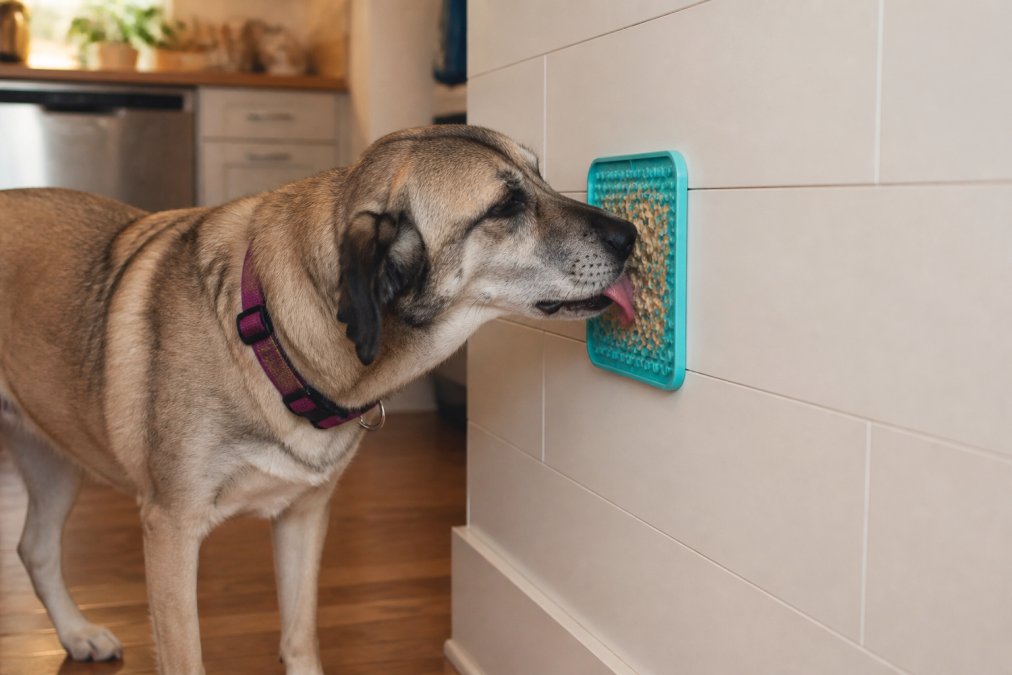
Our Calming Dog Bed uses a deep-cushion, donut-shaped design that mimics the warmth and security of curling up with a pack, which helps anxious dogs settle instead of pacing. For active lickers, the Anxiety Relief Lick Mat turns a stressful moment into a calming one, and the Suction Lick Bowl sticks to tub walls or tile so your dog can self-soothe during grooming.


Desensitization, Counterconditioning, and Positive Reinforcement Training
Desensitization means exposing your dog to a trigger at a distance where they stay calm, then slowly closing that distance over days or weeks. Counterconditioning pairs that trigger with something good, like a treat or a favorite toy, so the dog's emotional response flips from fear to anticipation. Positive reinforcement training ties it together by rewarding the behavior you want instead of punishing the behavior you don't.
If your dog reacts to other dogs at 50 feet, start at 100 feet. Leash reactivity and resource guarding both respond well to this slow, reward-based approach, but only when the dog stays under threshold. Once they're over threshold, no learning happens.
When to Consider Medication vs. Behavioral Modification
Medication is worth discussing when behavioral modification alone isn't reducing distress after weeks of consistent work, or when a dog is too anxious to eat, sleep, or learn. That last point is the one most owners miss: if your dog is over threshold most of the day, no training protocol can take hold, because learning requires a brain that isn't in survival mode.
This isn't a choice between training and medication. It's a question of sequencing. Think of medication as lowering the anxiety floor so behavioral modification can actually build the long-term skills. Most veterinary behaviorists describe the two as working in parallel, not in competition.
What a Veterinarian Might Actually Discuss
There are two broad categories of anti-anxiety medication for dogs, and it helps to know the difference before your appointment.
- Daily, long-term medications are given on a schedule regardless of what's happening that day. They build up in the system over weeks and are used for chronic, generalized anxiety. Common examples include fluoxetine and clomipramine (vcahospitals.com). These are not sedatives, a well-dosed dog should still be alert and able to train.
- Event or situational medications are given before a known stressor like fireworks, a vet visit, or a thunderstorm. They work within an hour or two and wear off. Common examples include trazodone and gabapentin, often prescribed in combination.
A veterinarian will typically want bloodwork before starting a daily medication, and follow-up visits to adjust the dose. Side effects like appetite changes, lethargy, or gastrointestinal upset are common in the first two weeks and often fade. Never stop a daily medication abruptly, taper under veterinary guidance.
Low-Risk Tools to Try First
Before or alongside a medication conversation, several low-risk additions are worth trying. Pheromone diffusers mimic the calming scent a mother dog produces for her puppies. A Thundershirt applies gentle, constant pressure that some dogs find grounding. White noise masks triggering sounds. None of these are treatments on their own, but they can take the edge off while training progresses.
How to Have the Conversation
Bring data, not just feelings. A two-week log of when anxiety happens, what triggers it, how long it lasts, and what you've already tried gives your veterinarian something concrete to work with. Ask directly: "Is my dog's quality of life affected enough that medication is worth discussing?" A good veterinarian will walk you through the trade-offs rather than push a decision.
If your dog shows fear-based behavior that puts anyone at risk, growling, snapping, or biting, get professional help rather than pushing through alone. A veterinary behaviorist, who is a veterinarian with additional board certification in behavior, is the right resource for complex or dangerous cases. A certified professional dog trainer can handle the training side but cannot prescribe.
| Situation | First Step | When to Escalate |
|---|---|---|
| Mild anxiety, settles within days | Safe space, routine, enrichment | If no improvement in 3 weeks |
| Fear of specific triggers | Desensitization at safe distance | If dog won't eat or learn |
| Severe panic, self-injury | Vet consult immediately | Same week, don't wait |
| No progress after 4-6 weeks of training | Log behavior, book vet appointment | Discuss daily medication |
| Predictable stressor (fireworks, travel) | Ask vet about situational medication | 1-2 weeks before the event |
Taking Care of Yourself While Helping Your Rescue Dog
Owner burnout is real, and it's the quiet reason many rescue placements fail. You cannot pour calm into a dog when you're running on no sleep and constant worry. Give yourself permission to crate your dog for a nap, step outside for twenty minutes, and ask a friend or foster network for help.
Progress with rescue dog anxiety is rarely linear. Some weeks feel like backsliding, and that's normal. Track small wins, celebrate a relaxed sigh or a first tail wag, and remember that trust building takes the time it takes. Your dog isn't giving you a hard time, they're having a hard time.
Frequently Asked Questions
What is the 3-3-3 rule for dogs with anxiety?
The 3-3-3 rule breaks the adjustment period into three phases: 3 days to decompress and feel safe, 3 weeks to settle into a routine and show personality, and 3 months to fully trust and feel at home. During the first 3 days, keep things quiet and avoid overwhelming your dog with visitors or new experiences. By 3 weeks, many dogs start relaxing into predictable schedules. At 3 months, most rescue dogs show their true temperament and form strong bonds. This timeline helps owners set realistic expectations and avoid pushing too fast.
How can I tell if my rescue dog has separation anxiety?
Signs of separation anxiety in dogs include pacing, whining, howling, destructive chewing, scratching at doors or windows, and house soiling when left alone. These behaviors typically happen within 30 minutes of your departure. Some dogs also drool excessively, pant, or try to escape crates. Unlike boredom, separation anxiety is a panic response. If your dog only shows these behaviors when you leave, it is likely separation anxiety. A certified professional dog trainer or veterinary behaviorist can confirm the diagnosis and build a behavior modification plan tailored to your dog.
What are the best calming tools for anxious rescue dogs?
Calming enrichment toys for dogs, like lick mats and slow feeder plates, work well because licking is a natural self-soothing behavior. A calming dog bed with a raised rim gives anxious dogs a secure place to curl up. Other helpful tools include white noise machines, pheromone diffusers, and Thundershirts for situational stress like thunderstorms. Pair these with a predictable routine and a quiet safe space. For severe anxiety, combine these tools with desensitization and counterconditioning under the guidance of a certified professional dog trainer.
When should I consult a professional trainer for my rescue dog?
Consult a certified professional dog trainer or veterinary behaviorist if your dog's anxiety does not improve after several weeks of consistent routine, safe space, and positive reinforcement. Seek help sooner if your dog injures themselves during panic, shows aggression from fear, or if you feel overwhelmed. A veterinary behaviorist can also discuss medication vs. behavioral modification. Medication is not a failure; for some dogs it lowers anxiety enough that training finally works. Your veterinarian can rule out medical causes and refer you to the right specialist.
Helping a rescue dog through anxiety takes consistency, the right tools, and more patience than most people expect. Furbabies4less was built around exactly this kind of care, with vet-informed product selections, a rescue-inspired philosophy, and a portion of every sale supporting animal rescues. Our calming beds, lick mats, and enrichment feeders are chosen to make the hard days easier for both of you. Get started with Furbabies4less and give your rescue the calm, supportive home they deserve.
