

Durable Toys for Destructive Chewers: 2026 Review
Table of Contents
- Why Destructive Chewers Need Heavy-Duty Toys
- How We Evaluated Durable Toys for Destructive Chewers
- Tough Chew Rubber Toy for Aggressive Chewers: Best Overall
- Enrichment Licking Plate: Best for Mental Stimulation for Destructive Dogs
- Anxiety Relief Lick Mat: Best for Anxious Chewers
- How to Stop Dog Furniture Chewing: A Practical Plan
- Safety, Sizing, and Supervised Play Guidelines
- Which Durable Toy Should You Pick?
- Frequently Asked Questions
Last Updated: October 2, 2026
Why Destructive Chewers Need Heavy-Duty Toys
A dog that destroys every soft toy in minutes isn't being bad. It's being a dog with a jaw that needs more resistance than most toys can offer. Durable toys for destructive chewers exist because the standard plush squirrel was never built to survive a determined Labrador.
At Furbabies4less, we hear the same story constantly: another toy in the trash, another couch cushion opened up. The pattern isn't random. Dogs chew for jaw strength, teething relief, boredom relief, and anxiety management. When a toy gives out too fast, the dog simply redirects that drive somewhere else, usually your furniture.
The fix starts with material density and tear resistance, not marketing claims.
How We Evaluated Durable Toys for Destructive Chewers
We judged each durable toy on five criteria: material toughness, dental safety, safety features, enrichment value, and real-world wear and tear.
Our scoring weighted material density and tear resistance highest, because those two factors decide whether a toy lasts a week or a year. We weighted dental safety second, because a toy that survives the chew but cracks a tooth has failed at its job.
| Criterion | What We Checked | Why It Matters |
|---|---|---|
| Material toughness | Rubber density, solid core, resists crushing | Determines replacement cycle |
| Dental safety | Flex under bite force, no rock-hard surfaces | Prevents tooth fractures |
| Safety features | Non-toxic, food-grade, no sharp edges | Prevents injury and ingestion risk |
| Enrichment value | Treat-fillable, textured, interactive | Reduces destructive behavior |
| Durability | Wear and tear after repeated use | Cost per month of use |
How we tested
Testing a chew toy is not a one-afternoon job. Our process runs across a full rotation cycle:
- Baseline inspection. Photograph the toy, note its weight and dimensions, and record the material type.
- Supervised chew sessions. Offer the toy for 15-20 minute sessions, three times per week, to dogs across the light, moderate, and power chewer tiers.
- Post-session inspection. Check for surface scoring, seam lift, chunk loss, and softening. Log each finding.
- Stress check. For rubber toys, squeeze the walls to confirm they rebound rather than stay compressed. For nylon, press a fingernail in to gauge hardness.
- Retirement trigger. A toy is retired the moment it fails the chunk test or shows a crack deeper than a fingernail.
What we will not recommend
A few categories fail our criteria outright, no matter how they are marketed:
- Rock-hard nylon and antler-style chews marketed as "indestructible." They survive the chew and damage the teeth.
- Toys with glued seams or press-fit squeakers that a power chewer can work loose.
- Any toy labeled "chew-proof." No toy is truly chew-proof, and any brand promising that is overselling.
A note on "indestructible" labels
A common mistake is buying on "indestructible" labels alone. Durability is a spectrum, not a binary, and the useful question is not "will it survive?" but "how long, under what supervision, and at what risk to the teeth?" A toy that lasts three months with no dental risk beats a toy that lasts a year and chips a molar.
Tough Chew Rubber Toy for Aggressive Chewers: Best Overall
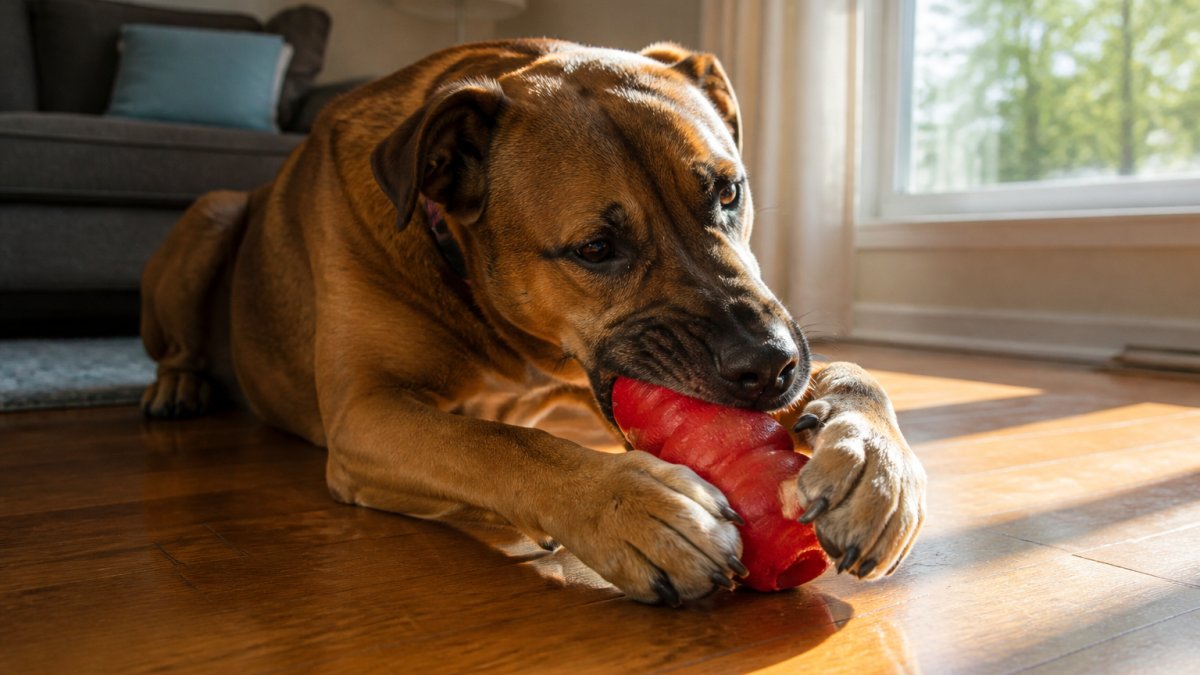
The best overall pick for an aggressive chewer is a heavy-duty rubber toy with a solid core and a hollow center for treats. The Tough Chew Rubber Toy for Aggressive Chewers from Furbabies4less fits that brief at $25.99.

It's built from ultra-durable non-toxic rubber that bounces back rather than cracking under bite force. The textured surface cleans teeth, massages gums, and reduces plaque buildup while your dog works.
What most reviews miss is that a hollow, fillable toy does double duty: it satisfies the chewing instinct and provides mental stimulation at the same time. The one drawback is that no rubber toy survives a dog who's determined to shred rather than chew, so supervised play still matters.
Enrichment Licking Plate: Best for Mental Stimulation for Destructive Dogs
Mental stimulation for destructive dogs often matters more than another chew toy. The Enrichment Licking Plate ($21.28) turns a meal into a problem-solving activity that leaves a dog mentally tired and behaviorally calm.

Textured grooves require focus and strategy to lick clean. The suction base sticks to any smooth surface, so it works hands-free on a floor, wall, or fridge.
This is where the real difference shows up. A bored dog creates its own problems, usually involving your furniture. A plate that channels that drive into a safe activity solves the cause, not just the symptom.
Anxiety Relief Lick Mat: Best for Anxious Chewers
For anxious chewers, calming matters as much as toughness. The Anxiety Relief Lick Mat ($21.70) works with a dog's own biology: repetitive licking triggers endorphins and serotonin, the same calming chemicals released during play.

It's built for thunderstorms, fireworks, separation, grooming, and vet visits. The suction base sticks anywhere for hands-free calming, and the textured surface redirects anxious energy into a focused outlet.
A common mistake is waiting until the trigger hits to introduce the mat. Teach your dog to use it during calm moments first, so the behavior is already familiar when stress arrives.
How to Stop Dog Furniture Chewing: A Practical Plan
Stopping furniture chewing starts with removing the cause, not just blocking the symptom. Most destructive chewing traces back to boredom, excess energy, or anxiety, and each one needs a different response.
Tough Chew Rubber Toy for Aggressive Chewers →
Try this plan:
- Rule out medical causes with your vet, especially for sudden new chewing
- Increase daily physical exercise to drain excess energy
- Add mental stimulation with a licking plate or treat-filled toy
- Redirect to an appropriate durable toy the moment chewing starts
- Manage anxiety with a lick mat during known triggers
- Crate or confine during unsupervised alone time
- Rotate toys weekly so novelty stays high
The thing nobody tells you about how to stop dog furniture chewing is that punishment backfires. A dog scolded hours later can't connect the correction to the act, and anxiety-driven chewing gets worse, not better.
Safety, Sizing, and Supervised Play Guidelines
Safety comes down to three things: the right size, the right material, and supervision. Get any one wrong and a durable toy becomes a hazard instead of an outlet. The sections below break each one into concrete rules you can apply before your dog ever touches the toy.
Sizing by jaw strength, not just body weight
A common mistake is sizing a toy to the dog's weight. Jaw strength matters more. A 45-pound terrier mix can out-chew a 90-pound couch potato, so match the toy to how the dog chews, not how much it weighs.
- Light chewer: nibbles, rarely damages plush. Standard rubber toys in the 3-5 inch range are fine.
- Moderate chewer: destroys plush in hours, dents softer rubber. Step up to solid-core natural rubber, 5-7 inches.
- Power chewer: shreds "tough" toys in a single session, crushes hollow balls. Needs thick-walled natural rubber or reinforced nylon, 7 inches and up.
- Extreme chewer: damages most rubber, targets seams and edges. Requires the densest rubber available plus strict supervision, no toy is truly chew-proof for this group.
As a rule, the toy should be large enough that your dog cannot fit it fully behind the molars, and heavy enough that it does not flip up into the throat during a hard chew session.
Material hardness and dental risk
Hardness is where most guides go quiet, and it is where the real injuries happen. A toy that does not flex at all transfers the full bite force back into the tooth.
A practical test: press a fingernail into the material. If it leaves no mark and the toy feels like a rock, it is too hard for routine chewing.
Supervised play rules that actually hold up
Supervision is not "stay in the room." It means watching for the specific failure modes that precede an emergency:
- The chunk test: if a piece the size of a golf ball can break off, that toy is not safe unsupervised for a power chewer.
- The seam check: run a thumb along every seam and molded edge. A lifted seam is the first place a determined chewer will win.
- The end-of-session sweep: inspect after every session, not every week. Cracks, missing chunks, and loose squeakers mean immediate retirement.
- The swap rule: trade the chew toy for a lick mat or food puzzle before your dog gets bored enough to start hunting for weak points.
When to retire a toy
Retire a durable toy the moment you see any of the following: a crack deeper than a fingernail, a missing piece you cannot account for, a squeaker that has come loose, or a surface that has gone tacky and soft. A toy that has been chewed down to a nub is also a choking risk, even if it looks intact.
Which Durable Toy Should You Pick?
Match the toy to the behavior. A dog who shreds plush toys needs a heavy-duty rubber chew toy. A dog who chews out of boredom needs enrichment.
| If Your Dog... | Pick This | Price | Why |
|---|---|---|---|
| Destroys soft toys fast | Tough Chew Rubber Toy | $25.99 | Solid rubber, resists crushing |
| Chews from boredom | Enrichment Licking Plate | $21.28 | Mental stimulation, slow feeder |
| Chews from anxiety | Anxiety Relief Lick Mat | $21.70 | Calming, redirects anxious energy |
Most destructive chewers need two of the three. Pair a tough chew toy for active sessions with a lick mat for wind-down time, and you cover both the physical and mental sides of the habit.
Frequently Asked Questions
What are the most durable materials for dog chews?
The two most common materials in durable toys are natural rubber and nylon. Natural rubber, like the non-toxic rubber used in the Tough Chew Rubber Toy, flexes under pressure and bounces back, which helps it resist cracking. Nylon bones are harder and longer-lasting but can wear down enamel if a dog chews them constantly. Look for food-grade or non-toxic labels, and avoid any toy that shows deep gouges or loose pieces after a few sessions.
How can I tell if a toy is safe for my aggressive chewer?
Check three things: material density, size, and wear indicators. A toy should be thick enough that your dog cannot compress it flat with their back teeth. It should be large enough that they cannot swallow it. After each session, inspect for cracks, missing chunks, or exposed seams. If you can dent it with a fingernail, it will not survive a determined chewer. Replace any toy that shows significant wear and tear.
What should I do if my dog destroys every toy I buy?
First, switch to toys made from heavy-duty rubber or solid-core nylon instead of plush or thin vinyl. Second, add mental stimulation for destructive dogs through enrichment tools like a licking plate loaded with peanut butter or wet food. Third, increase supervised play with interactive toys that require problem-solving. A tired, mentally engaged dog chews less out of boredom. If destruction continues, consult your veterinarian to rule out dental pain or anxiety.
How do I stop dog furniture chewing when I am not home?
Set up a management and enrichment routine. Crate or confine your dog in a puppy-proofed area with a durable chew toy and a frozen licking plate. Exercise them thoroughly before you leave. Rotate toys weekly so they stay novel. For anxious dogs, the Anxiety Relief Lick Mat can lower cortisol through repetitive licking. Consistency matters more than any single product. Most dogs need two to four weeks of this routine before furniture chewing drops off.
Are durable toys for destructive chewers worth the higher price?
Yes, when you compare cost per month of use. A $25.99 heavy-duty rubber toy that lasts six months costs about $4.33 per month. A $10 plush toy destroyed in two days costs $150 over the same period. Durable toys also reduce the risk of swallowed stuffing or plastic fragments, which can lead to expensive vet visits. The upfront price is higher, but the replacement cycle is much longer.
Destructive chewing is exhausting, and it's easy to feel like you've tried everything. Furbabies4less exists for exactly this: vet-informed enrichment toys and calming tools chosen to hold up under real use, with a portion of every sale supporting animal rescues. Start with the Tough Chew Rubber Toy for the shredders, add a licking plate for the bored, and keep a lick mat ready for stressful days. Shop Furbabies4less and give your dog an outlet that actually works.
