

Best Wet Food for Cats With Digestive Issues: 2026 Review
Table of Contents
- How We Reviewed Wet Food for Cats With Digestive Issues
- Best Cat Food for Sensitive Stomach: What to Look For
- Wet or Dry Food for Cats With Digestive Issues?
- Wet Cat Food for Cats With IBD: Prescription vs Over-the-Counter
- How to Transition a Cat to New Food Without Triggering a Flare-Up
- Matching Wet Food Texture to Your Cat's Symptoms
- When Digestive Symptoms Need a Veterinarian, Not a New Food
- Conclusion: Choosing Wet Food for Cats With Digestive Issues
- Frequently Asked Questions
Last Updated: October 13, 2026
How We Reviewed Wet Food for Cats With Digestive Issues
Finding the best wet food cats with digestive issues can eat starts with one rule: ignore the marketing and read what's inside the can. At Furbabies4less, we built our review process around ingredients, guaranteed analysis, texture, and performance during a slow transition.
We do not run a testing lab, and we will not pretend otherwise. What we do is read labels the way a careful pet parent should, cross-check claims against AAFCO's pet food labeling and nutrient profile standards, and flag the gaps between what a brand promises and what its guaranteed analysis shows.
Our Four Review Criteria
Every food was judged against four fixed criteria:
- Ingredient clarity, Is the primary protein named, or hidden behind "meat by-products"?
- Guaranteed analysis, Do the protein, fat, and fiber percentages match the food's stated purpose?
- Texture and moisture, Does the form suit a cat with vomiting, loose stool, or picky eating habits?
- Transition friendliness, Can the food be mixed gradually without triggering a flare-up?
Best Cat Food for Sensitive Stomach: What to Look For
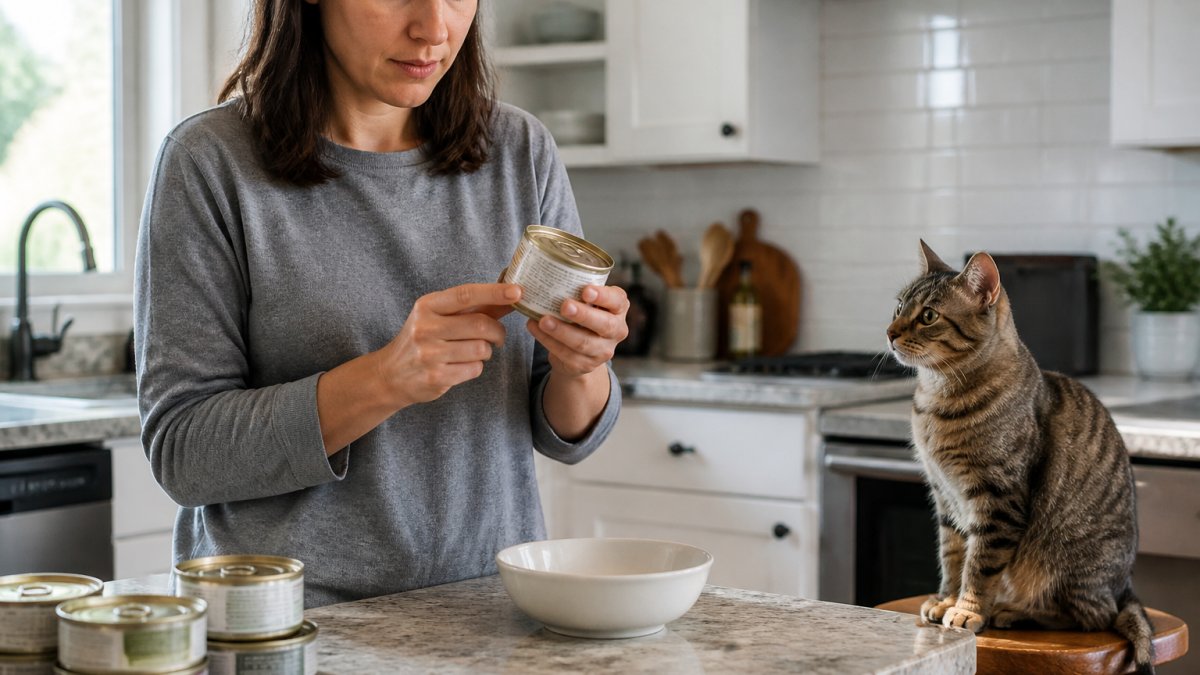
The best cat food for a sensitive stomach is a complete and balanced wet food with a single named protein, moderate fat, and no artificial colors or preservatives. Check the label in this order:
- Named protein first. "Chicken," "turkey," or "salmon" beats "poultry" or "meat."
- Limited ingredients. Fewer components means fewer chances of a food sensitivity.
- Moderate fat. High-fat recipes can worsen loose stool in some cats.
A limited-ingredient diet is built around one protein and one carbohydrate source, making it easier to spot what a cat reacts to. If you have never identified your cat's trigger, start here.
Wet or Dry Food for Cats With Digestive Issues?
Wet food cats with digestive issues can tolerate is usually the better choice because its high moisture content supports hydration, and hydration supports normal digestion. Cats evolved to get most of their water from prey, not a bowl.
Dry food is not automatically bad, but when a cat is vomiting, passing loose stool, or eating less than usual, moisture becomes a real advantage. Wet food is also more palatable, which matters for a cat who has gone off their food. The trade-offs:
| Factor | Wet Food | Dry Food |
|---|---|---|
| Moisture content | High, supports hydration | Low, requires more drinking |
| Palatability | Usually higher | Varies by cat |
| Cost per day | Higher | Lower |
| Storage | Refrigerate after opening | Shelf-stable |
| Best for | Hydration, picky eaters, seniors | Budget, free-feeding |
Wet Cat Food for Cats With IBD: Prescription vs Over-the-Counter
Cats with inflammatory bowel disease usually need a prescription diet, not a shelf-stable alternative. IBD is a diagnosed condition, and the food that manages it is typically chosen by your veterinarian based on your cat's specific case. The distinction between a prescription gastrointestinal diet and an over-the-counter sensitive-stomach recipe is not marketing, it is a difference in formulation intent, protein processing, and how the food is positioned under AAFCO's pet food labeling and nutrient profile standards.
What Makes a Prescription GI Diet Different
Prescription gastrointestinal diets are formulated for a clinical purpose and sold only through a veterinarian or with veterinary authorization. They fall into three families:
- Hydrolyzed protein diets. Protein is broken into fragments small enough that the immune system is less likely to react. Common bases include hydrolyzed chicken, soy, and feather meal. These are first-line when a food allergy or immune-mediated reaction is suspected.
- Novel protein diets. The formula uses a protein the cat has likely never eaten, venison, rabbit, duck, or alligator. If the immune system has never seen it, it is less likely to have mounted a response.
- Fiber-modified and low-fat GI diets. These adjust soluble and insoluble fiber (often psyllium or fermentable fibers) and reduce fat to ease digestion in cats with chronic loose stool, pancreatitis history, or lymphangiectasia.
A prescription GI diet is not automatically better for every cat, it is better for the clinical picture it was designed to address. Typical candidates: a confirmed IBD diagnosis, food-responsive enteropathy, or chronic vomiting that has not resolved on an elimination trial.
Where Over-the-Counter Food Fits
Over-the-counter sensitive-stomach recipes are not prescription diets, even when labels look similar. They meet AAFCO nutrient profiles for a life stage, not manage a diagnosed condition. Where they fit:
- Cats with mild, occasional digestive upset
- Cats whose trigger has already been identified and avoided
- Cats transitioning off a prescription diet under veterinary guidance
A common pattern: a cat does well on a prescription hydrolyzed diet for months, then is gradually transitioned to a limited-ingredient over-the-counter recipe once symptoms are stable. That transition should be directed by your veterinarian, not improvised at home.
How to Read a Prescription GI Label
Prescription labels carry information an over-the-counter can does not:
- The AAFCO nutritional adequacy statement. It should state the food is complete and balanced for the cat's life stage, or intended for intermittent or supplemental feeding only. A therapeutic diet that is not complete and balanced is not a maintenance food.
- The protein source and processing method. "Hydrolyzed" or "novel" should appear explicitly. If the label only says "chicken" or "salmon," it is not hydrolyzed.
- The guaranteed analysis. Compare protein, fat, and fiber against the clinical goal. A low-fat GI diet shows fat well below a standard maintenance recipe.
If your cat has a confirmed IBD diagnosis, treat the prescription diet as the baseline. Ask your vet before swapping it, and bring the label of any food you are considering so you can compare formulations directly.
How to Transition a Cat to New Food Without Triggering a Flare-Up
A slow transition is the most reliable way to avoid a flare-up. Most cats need seven to ten days; some need longer. The standard mix:
- Days 1-2: 75% old food, 25% new food
- Days 3-4: 50% old food, 50% new food
- Days 5-7: 25% old food, 75% new food
- Day 8 onward: 100% new food
Watch the litter box, not just the bowl. If stool gets looser or vomiting returns, step back to the previous ratio for a few more days. A slower transition costs nothing; a flare-up costs a vet visit.
Matching Wet Food Texture to Your Cat's Symptoms
Texture is the most overlooked variable in digestive care, and it often explains more than the ingredient list. A pâté, a chunky stew, and a bisque can share nearly identical nutrition and produce completely different results in the same cat. Texture is a mechanical and behavioral issue, and matching it to the specific symptom is the fastest way to narrow down the cause.
Why Texture Affects Digestion
Three mechanisms explain most texture-related upset:
- Eating speed. Chunky food requires chewing, which slows a cat down. Smooth pâté can be licked up in seconds, so a cat may swallow more air and eat faster, triggering vomiting shortly after the meal. The fix is often delivery, not food: a lick mat, shallow dish, or slow-feeder bowl.
- Particle size and gut transit. Shredded and chunky textures arrive in the stomach in larger pieces, an advantage for cats with weak chewing or dental pain, a disadvantage with delayed gastric emptying. Smooth textures move through faster.
- Hydration and mixing. Pâté and mousse hold more added water than shredded recipes, supporting hydration. Bisques and broths add even more moisture but are often not complete and balanced alone.
Matching Texture to the Specific Symptom
Match the texture to what you are actually seeing:
- Vomiting shortly after eating: a smooth pâté in small, frequent portions, or the same food on a lick mat. If vomiting continues on a smooth texture, the issue is likely ingredient- or volume-related.
- Loose stool: a high-fiber pâté with added pumpkin or psyllium. Soluble fiber (psyllium, pumpkin) tends to firm stool; insoluble fiber (some beet pulp, cellulose) can loosen it in sensitive cats.
- Constipation: higher-moisture textures, bisque, or pâté with added water, plus a moderate fiber blend. Dry food is a common contributor.
How to Tell Texture Apart From Ingredients
A simple test: feed the same recipe in two textures, if the brand offers both. If symptoms improve on the smooth version and return on the chunky one, texture is the variable. If symptoms persist across both, the ingredient is the more likely cause. This controlled comparison is the fastest way to stop guessing.
Texture also affects eating speed. A cat that wolfs down chunky food may vomit from speed, not the food itself. A smoother texture can resolve that, but so can slowing the meal down. Try the cheaper fix first.
When Digestive Symptoms Need a Veterinarian, Not a New Food
Some symptoms mean stop adjusting the diet and call your vet. Food changes help with mild, occasional upset, not a medical problem. Contact your veterinarian if your cat has:
- Vomiting or diarrhea lasting more than 24 to 48 hours
- Blood in the stool or vomit
- Refusing food for more than a day
A cat who stops eating is at risk of serious liver problems within days, which is why appetite loss is urgent rather than wait-and-see. If you are unsure whether a symptom is serious, a phone call to your vet settles the question faster than another food trial.
Conclusion: Choosing Wet Food for Cats With Digestive Issues
The right wet food for a cat with digestive issues comes down to three things: a named protein, a texture your cat will actually eat, and a transition slow enough to prove it works.
At Furbabies4less, we stock vet-informed essentials chosen to make that process easier, from feeders that slow down fast eaters to gentle grooming tools for cats who hate being handled.
Frequently Asked Questions
What is the best moist cat food for a sensitive stomach?
There is no single best product, because tolerance varies by cat. Look for a limited-ingredient wet food with one named animal protein, no artificial colors or preservatives, and a "complete and balanced" statement from the Association of American Feed Control Officials on the label. Pâté textures are often easier on cats with loose stool because they contain less added liquid and fewer gums. Introduce any new food over 7 to 10 days, and stop if vomiting or diarrhea gets worse.
Is wet food or dry food easier on a cat's stomach?
Wet food usually wins for cats with digestive issues. Its moisture content, often around 75 to 80 percent, supports hydration, which matters when vomiting or diarrhea increases fluid loss. Wet food also tends to carry fewer carbohydrates than dry kibble, and many cats with food sensitivities tolerate a low-carb, high-protein recipe better. Dry food is more convenient and cheaper per day, so some owners feed both. If your cat has a diagnosed condition, follow your veterinarian's recommendation on which form to use.
Which ingredients should I look for in wet food for a cat with digestive issues?
Start with a single named protein such as chicken, turkey, or salmon, listed first on the label. Check for a named fat source, added taurine, and a vitamin and mineral blend that makes the recipe complete and balanced. Avoid artificial colors, flavors, and preservatives, and note whether carrageenan or guar gum appears, since some cats react to thickeners. If your cat has been diagnosed with IBD, your veterinarian may steer you toward a hydrolyzed or novel-protein prescription diet instead of an over-the-counter can.
When should I ask a veterinarian about my cat's digestive symptoms?
Call your veterinarian if vomiting happens more than twice in a day, diarrhea lasts longer than 24 to 48 hours, or you see blood in the stool or vomit. Weight loss, refusing food for more than 24 hours, lethargy, or straining in the litter box also warrant a visit. Kittens, senior cats, and cats with a known condition like IBD or kidney disease should be seen sooner. A veterinarian can rule out parasites, pancreatitis, or an obstruction before you spend more money cycling through cans of food.
