

5 Best Slow Feeder Bowls for Flat-Faced Cat Breeds
Table of Contents
- Why Flat-Faced Cats Need a Different Slow Feeder Bowl
- Quick Comparison: 5 Slow Feeder Bowls at a Glance
- 1. Smart Slow Puzzle Feeder Bowl: Best Overall for Flat-Faced Cats
- 2. Digestive Health Slow Feeder Bowl: Best Shallow Profile for Short Muzzles
- 3. Interactive Lick Ball: Best Slow Feeder Bowl for Wet Food
- 4. Suction Lick Bowl: Best for Stability and Easy Cleaning
- 5. Anxiety Relief Lick Mat: Best Low-Barrier Option for Nervous Eaters
- Choosing a Slow Feeder Bowl for Persian Cats
- Frequently Asked Questions
Last Updated: October 21, 2026
Why Flat-Faced Cats Need a Different Slow Feeder Bowl
Flat-faced cats, known as brachycephalic breeds, have a compressed skull that shortens the muzzle and narrows the airway. That anatomy changes everything about how they pick up food.
The right slow feeder bowls for flat-faced cats share one trait: a wide, shallow eating surface with low ridges. Deep mazes and tall walls work against a Persian or Exotic Shorthair, not for them.

Below, we break down five picks by feeding style, with prices and the trade-offs that actually matter.
Cornell Feline Health Center on brachycephalic breeds
How a Short Muzzle Changes the Way a Cat Eats
A brachycephalic cat cannot scoop food the way a long-nosed cat does. The flat face means the tongue has to do more work, and the jaw opens at a shallower angle.
Fast eating in flat-faced cats carries real risk. Swallowed air builds up because the airway is already narrow, and many owners report post-meal vomiting and gas. A shallow bowl with gentle obstacles slows the pace without blocking access.
Quick Comparison: 5 Slow Feeder Bowls at a Glance
Here is how the five picks line up on price, best use, feeding format, and the fit details that matter for a short muzzle. Because most listings do not publish maze depth or usable surface area, treat the fit notes as the deciding column, not the marketing copy.
| Pick | Price | Best For | Food Type | Fit Note for a Flat Face | Cleaning |
|---|---|---|---|---|---|
| Smart Slow Puzzle Feeder Bowl | $25.99 | Best overall | Dry kibble | Wide channels; start with a thin kibble layer so nothing sits deep | Dishwasher safe |
| Digestive Health Slow Feeder Bowl | $19.99 | Shallow profile | Dry or wet | Low ridges across a broad plate; easiest reach for a short muzzle | Dishwasher safe |
| Interactive Lick Ball | $3.74 | Wet food | Wet, pureed, paste | Rolling 3D surface; food stays at the surface, not below the muzzle | Dishwasher safe |
| Suction Lick Bowl | $19.75 | Stability and cleaning | Wet, pureed | Mounts vertically so you can set reach height; smooth surfaces only | Dishwasher safe |
| Anxiety Relief Lick Mat | $21.70 | Nervous eaters | Wet, pureed | Flattest surface here; lowest barrier, least challenge | Dishwasher safe |
What the Table Does Not Tell You
Price and food type are easy to compare. Fit is not. Two bowls can both say "slow feeder" and behave completely differently for a Persian or Exotic Shorthair, because the variable that matters is how far the food sits below the rim and how wide the openings are.

A practical way to judge any bowl before buying:
- Rim-to-food depth. If the food sits more than roughly an inch below the rim, a flat-faced cat has to press its nose in to reach it. Shallow wins.
- Opening width. Channels and grooves should be wide enough for the muzzle to enter without the whiskers folding flat against a wall.
- Usable surface area. A large dog plate may only be partly reachable by a small cat; the effective eating area is smaller than the listed size.
- Stability. A bowl that slides turns mealtime into a chase. Suction or a weighted non-slip base matters more for a cat already working harder to eat.
- Residue in grooves. Deep texture traps wet food. If the design has narrow grooves, plan on a soak before the dishwasher.
Matching the Bowl to the Food
Dry kibble needs a surface that spreads pieces apart without burying them. A puzzle bowl with reachable channels does that; a flat mat barely slows kibble at all.
Wet and pureed food needs a lick surface, ball, or mat. Kibble mazes do nothing for pate, and a flat dish lets a cat clean it in seconds. The lick ball and both lick surfaces here are built for that format.
Mixed feeding is the common case, and it is where most single-bowl advice breaks down.
1. Smart Slow Puzzle Feeder Bowl: Best Overall for Flat-Faced Cats
Our top pick for most flat-faced cats is the Smart Slow Puzzle Feeder Bowl.
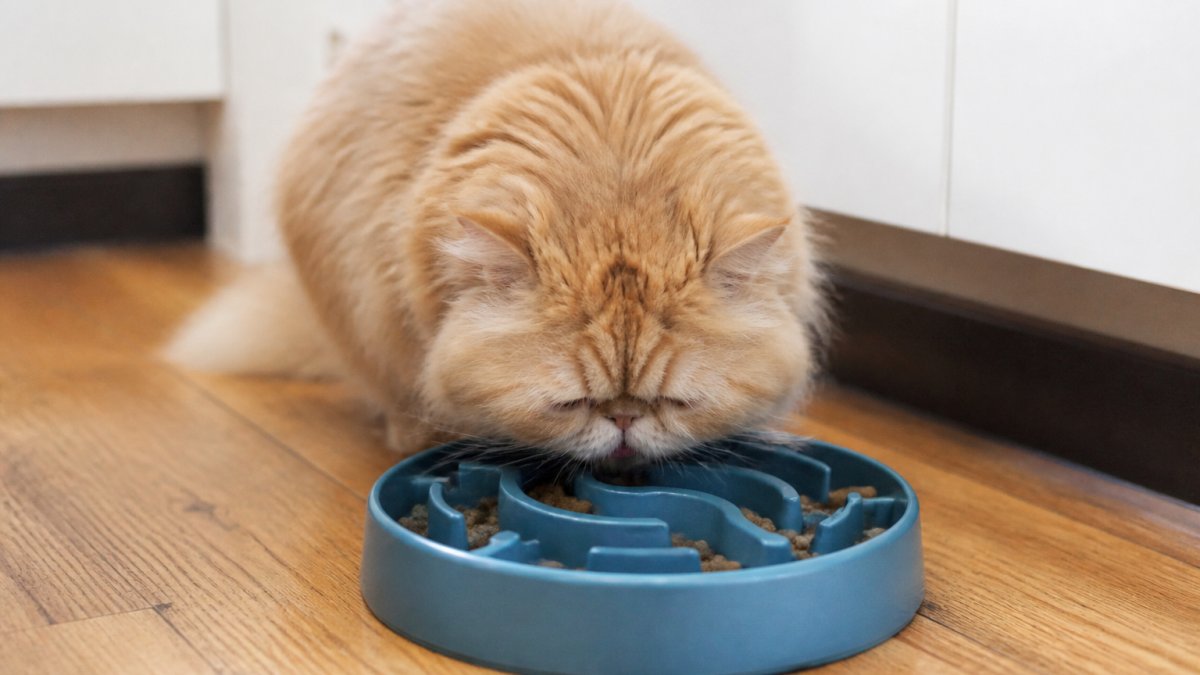
The puzzle design slows eating by spreading kibble across ridges and channels. That extra work turns mealtime into a mental task, which helps cats that gulp their food and then vomit.
Where it falls short: the maze is still a maze. For a cat with an extremely flat face, start with a thin layer of kibble so nothing sits deep in a channel.
2. Digestive Health Slow Feeder Bowl: Best Shallow Profile for Short Muzzles
If your cat struggles to reach into any bowl, the Digestive Health Slow Feeder Bowl solves the access problem first.
The suction base locks to smooth floors, which stops the bowl from sliding as your cat works. The textured surface slows eating and reduces the gulped air that leads to bloating.
The trade-off is that it is built for dogs, so the plate is larger than a cat needs. That is not a dealbreaker, but a small cat may only use part of the surface.
3. Interactive Lick Ball: Best Slow Feeder Bowl for Wet Food
Wet food is where most slow feeders fail. The Interactive Lick Ball handles wet food differently: your cat has to rotate, nose, and paw the ball to reach the pureed food inside.

This 3D design keeps a flat-faced cat engaged longer than a flat mat because the food shifts as the ball moves. Licking also releases calming endorphins, which helps anxious eaters settle.
Smart Slow Puzzle Feeder Bowl for Dogs & Cats →
At $3.74, it is the cheapest pick on this list by a wide margin. The catch: it suits wet, pureed, or paste-like food only. Do not load it with dry kibble.
4. Suction Lick Bowl: Best for Stability and Easy Cleaning
A bowl that slides across the floor is a bowl your cat will chase instead of eat from. The Suction Lick Bowl locks firmly to tile, glass, tubs, and smooth floors with a heavy-duty suction base, so the feeding surface stays put.
The slow-feeding design spreads wet food across the bowl and extends mealtime, which reduces gulping and bloating. Because it sticks to a vertical surface as well as a floor, you can mount it at a height that suits your cat's posture.
Where it falls short: suction only holds on smooth surfaces. On carpet or textured flooring, it will not stick.
5. Anxiety Relief Lick Mat: Best Low-Barrier Option for Nervous Eaters
For a cat that is nervous around food, the lowest barrier wins. The Anxiety Relief Lick Mat is a flat surface with shallow texture, so a flat-faced cat can reach every bit of food without pressing its nose into a wall.
Repetitive licking triggers calming endorphins, which makes this mat useful for cats that eat fast out of stress rather than hunger. The suction base sticks to walls, floors, and tub surfaces, and it is dishwasher safe.
The honest limitation: a flat mat offers less of a challenge than a puzzle bowl. If your cat bolts dry kibble, this will slow it somewhat but not as much as the puzzle feeder.
Choosing a Slow Feeder Bowl for Persian Cats
Persians and Exotic Shorthairs need the same thing: a wide, shallow surface with low obstacles and a stable base. The mistake is buying a feeder built for a dog's long reach and expecting a flat-faced cat to manage it.
Match the bowl to the food first. Dry kibble needs a puzzle surface with reachable channels. Wet food needs a lick surface, mat, or ball.
AAHA nutrition and feeding guidance for pet owners
Breed-Specific Fit: Persian and Exotic Shorthair
Both breeds share the compressed face, but their temperaments differ. Persians tend to be calm, deliberate eaters who do well with a flat lick mat. Exotic Shorthairs are often more active and food-focused, and they take to a puzzle feeder with more enthusiasm.
How to Introduce a Slow Feeder to a Cat
Switching bowls too fast causes stress and food refusal. Introduce the new feeder over about a week.
- Day 1-2: Put the new bowl beside the old one, empty, so your cat investigates it.
- Day 3-4: Add a few treats to the new bowl and keep regular meals in the old one.
- Day 5-6: Serve half the meal in the new bowl, spread thin.
- Day 7: Serve full meals in the new bowl and remove the old one.
Watch for signs of frustration, like pawing the bowl or walking away. If your cat gives up, spread the food thinner and try again.
ASPCA on cat feeding and behavior enrichment
Flat-faced cats deserve a feeder built for their anatomy, not a dog bowl with a maze stamped into it. If you are not sure where to start, our Smart Slow Puzzle Feeder Bowl handles dry food for most brachycephalic cats, while the Interactive Lick Ball covers wet food at the lowest price on this list.
Frequently Asked Questions
Can you put wet food in a slow feeder bowl?
Yes, but the bowl style matters. Maze-style slow feeder bowls with deep ridges work best with dry kibble because wet food can pack into narrow channels and become hard to clean. For wet food, a lick mat, lick ball, or shallow textured plate is a better fit. The Interactive Lick Ball and the Anxiety Relief Lick Mat both work well with wet food, pureed treats, or yogurt, and they are dishwasher safe so cleanup stays simple.
Are slow feeder bowls suitable for flat-faced cats?
They can be, as long as the bowl is shallow and wide. Brachycephalic breeds like Persians and Exotic Shorthairs have a short muzzle and a flatter face, which makes it hard to reach food at the bottom of a deep bowl. Look for a slow feeder bowl with a low rim, wide food surface, and gentle ridges rather than tall maze walls. A bowl that forces the cat to press its face into a corner will usually cause the cat to give up eating.
My cat won't eat out of a slow feeder bowl. What should I do?
Start by checking the bowl depth. If your cat has to push its nose past a high rim, the bowl is too deep for a flat face. Try a shallower option first, like a lick mat or a low-profile plate. Then introduce it gradually: put a few pieces of food on the surface with no obstacles, and add ridges only once your cat is comfortable. Never switch bowls during a stressful week, and always keep a familiar bowl nearby during the transition.
What bowl shape is easiest for Persian cats to eat from?
A shallow, wide bowl with a low front edge is easiest for Persian cats. The wide surface lets food spread out instead of piling in the center, and the low rim means the cat does not have to tilt its head sharply or press its flat face into a wall. Whisker-friendly designs with no narrow sides also help, since a short muzzle plus a deep bowl is the combination that causes most eating difficulty.
How can I slow down a cat that eats too quickly without making meals difficult?
Use obstacles that add a small amount of effort, not a puzzle that frustrates. Spread wet food thinly across a lick mat, or use a puzzle bowl with shallow channels rather than tall walls. Split meals into two or three smaller servings so the cat is not ravenous at the start. For flat-faced cats, the goal is a slower eating pace with easy food access, so pick the shallowest slow feeder that still adds resistance and watch how your cat responds over the first week.
