

Vet Recommended Cat Wellness Toys: 2026 Buying Guide
Table of Contents
- Why Vet Recommended Cat Wellness Toys Matter
- Cat Enrichment Toy Benefits for Physical and Mental Health
- Comparing Toy Types: Interactive, Lick Mats, and Puzzle Feeders
- How to Choose Puzzle Feeders for Cats
- Safe Materials for Cat Toys: What to Avoid
- Toy Hygiene, Durability, and Eco-Friendly Options
- Frequently Asked Questions
Last Updated: September 10, 2026
Why Vet Recommended Cat Wellness Toys Matter
Veterinarians recommend cat wellness toys because they address the two biggest health risks facing indoor cats: obesity and chronic stress. Unlike generic pet-store picks, vet-informed selections are chosen for safety, durability, and how well they trigger natural feline behavior.
That distinction matters more than most owners realize. A toy that shreds into swallowable pieces or sits untouched in a corner doesn't just waste money. It leaves your cat sedentary, bored, and prone to the weight gain and anxiety that veterinary clinics see every week.
This guide from Furbabies4less breaks down what actually makes a toy worth buying, from prey-drive stimulation to safe materials. Below, we'll show you how to match a toy to your cat's personality, spot hidden choking hazards, and keep every purchase clean and long-lasting.
Cat Enrichment Toy Benefits for Physical and Mental Health
Cat enrichment toy benefits extend far beyond entertainment. Interactive play delivers real physical exercise and genuine mental stimulation, two things indoor cats rarely get enough of on their own.
Think about what a cat does in the wild: stalk, chase, pounce, bat, and problem-solve for food. An indoor cat with nothing to hunt can develop what vets call a sedentary lifestyle, which contributes to weight management problems and low mood. A wand toy that mimics prey, or a puzzle feeder that makes mealtime a challenge, restores some of that natural rhythm.
The mental side is just as important. Boredom relief isn't a luxury. Cats without outlets for their instincts often redirect that energy into scratching furniture, over-grooming, or stress behaviors. Enrichment gives that energy somewhere to go.
- Physical: chasing, pouncing, and climbing build muscle and burn calories
- Mental: puzzle solving and prey mimicry sharpen focus and reduce anxiety
- Emotional: interactive play with you strengthens bonding and lowers stress
American Association of Feline Practitioners on environmental enrichment notes that enrichment is a core part of feline wellness, not an optional extra.
Comparing Toy Types: Interactive, Lick Mats, and Puzzle Feeders
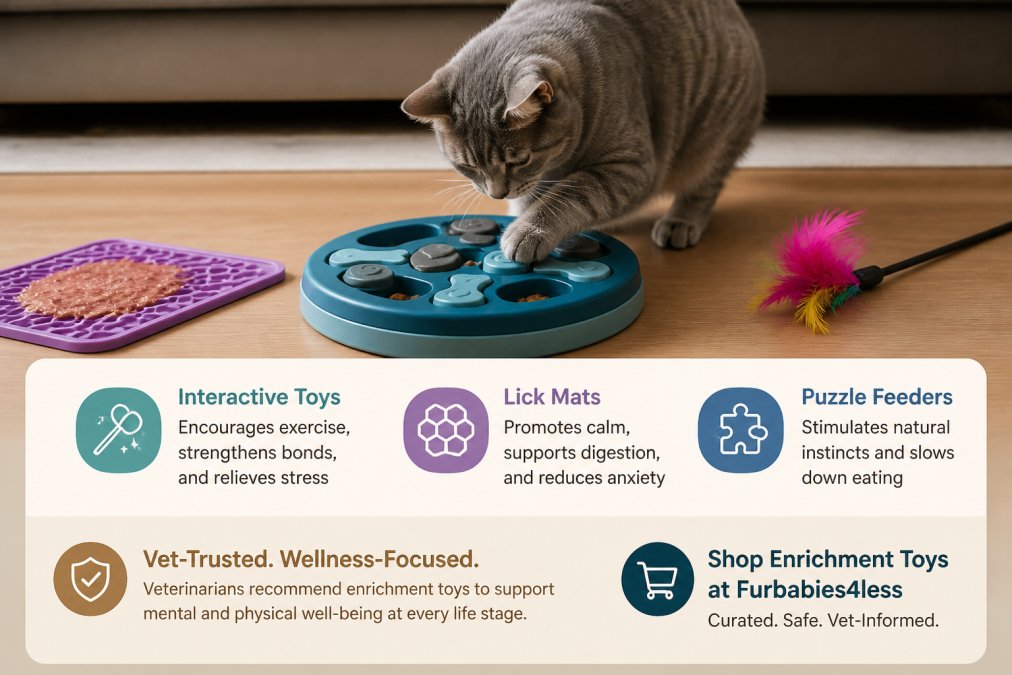
Each toy category solves a different problem. Interactive toys burn energy, lick mats calm anxiety, and puzzle feeders work the brain. Matching the type to your cat's need is the whole game, and the fastest way to do that is to map the toy to the behavior you're actually trying to change.
| Toy Type | Best For | Key Benefit | Play Style | Watch Out For |
|---|---|---|---|---|
| Interactive / wand | Prey drive, exercise, bonding | Chasing and pouncing | Supervised only | String ingestion if left out |
| Lick mats | Stress, fast eating, vet visits | Calming, slow feeding | Solo or supervised | Must be washed after each use |
| Puzzle feeders | Boredom, cognition, weight management | Mental stimulation | Solo | Too-hard puzzles frustrate cats |
| Self-moving / electronic | Nighttime activity, separation anxiety | Solo enrichment when you're away | Solo, with a timeout | Motors and batteries need inspection |
Interactive and Wand Toys for Prey Drive
Wand toys and self-moving balls tap directly into a cat's prey drive. The movement triggers the stalk-chase-pounce sequence, which is exactly the physical exercise indoor cats lack. A good session mimics a real hunt: let your cat stalk, then let it catch and "kill" the toy at the end. Skipping the catch step leaves cats frustrated, which is why some owners see play sessions end in a swat at their ankle.
The trick is unpredictability. A toy that moves in a straight line gets ignored fast. Look for erratic motion, feather or tail attachments, and enough durability to survive a determined hunter. Wand toys are supervised-only, put them away after every session, because a swallowed string can bunch in the intestines and require surgery.
Lick Mats and Slow Feeders for Stress Reduction
Lick mats turn a treat into a calming activity. The repetitive licking motion soothes anxious cats and slows down gulpers, supporting stress reduction and better digestion. They're especially useful before vet visits, during thunderstorms, or when introducing a new pet, the licking behavior is self-soothing, similar to how kittens nurse.
Spread wet food, plain yogurt, or pureed treats across the surface and freeze it for a longer session. Just plan to wash it thoroughly after every use, since residue left in the grooves becomes a hygiene problem. Silicone mats with deep grooves hold more food but take longer to clean; shallow mats are easier to sanitize but empty faster.
Puzzle Feeders for Cognitive Enrichment
Puzzle feeders make your cat work for food, delivering cognitive enrichment with every meal. Instead of eating from a bowl in two minutes, your cat noses, paws, and problem-solves. For cats carrying extra weight, this also slows eating and stretches mealtime, which helps with weight management.
Start easy and increase difficulty as your cat learns. A feeder that's too hard gets abandoned, which defeats the purpose. A common pattern is to begin with a rolling treat ball, then graduate to sliding trays, then multi-step mazes. If your cat solves a level in seconds, add complexity; if it walks away, step back one level.
Matching the Toy to the Behavioral Issue
Most guides list toy types without saying which problem each one solves. Here's a practical mapping:
- Separation anxiety: self-moving or electronic toys that run on a timer, plus a frozen lick mat left out when you leave
- Nighttime activity: a puzzle feeder used as the last meal before bed, so the cat works for food instead of waking you
- Weight management: puzzle feeders and slow feeders that stretch mealtime and reduce scarfing
- Over-grooming or stress behaviors: lick mats and interactive wand sessions that redirect anxious energy
- Multi-cat tension: one feeder per cat, placed in separate rooms, to prevent guarding
A practical option many owners start with is the Interactive Lick Ball for Dogs & Cats, a 3D slow feeder that makes pets rotate and paw the ball to reach the treat inside. It works for both cats and dogs, which is handy in mixed households.

How to Choose Puzzle Feeders for Cats
Learning how to choose puzzle feeders for cats comes down to difficulty level and your cat's temperament. The right feeder challenges without frustrating, and it matches how your cat already eats.
Start with a simple sliding or rolling design, then graduate to multi-step feeders as your cat solves each level. If your cat gives up and walks away, dial the difficulty back. If it solves the puzzle in seconds, add complexity.
Here's a quick decision framework:
- Food-motivated cat? Start with a rolling treat ball
- Anxious or shy cat? Choose a low-effort mat or shallow puzzle
- Fast eater? Use a maze feeder to slow mealtime
- Senior cat? Keep puzzles simple to avoid joint strain
- Multi-cat home? Get one feeder per cat to prevent guarding
A practical option many owners start with is the Interactive Lick Ball for Dogs & Cats, a 3D slow feeder that makes pets rotate and paw the ball to reach the treat inside. It works for both cats and dogs, which is handy in mixed households.
Safe Materials for Cat Toys: What to Avoid
Safe materials for cat toys come down to one rule: if a cat can chew it off, it can swallow it. Non-toxic materials and secure construction prevent the ingestion risks that send cats to the vet.
Avoid these outright:
- Loose strings and ribbons that can be swallowed and cause dangerous string ingestion
- Small bells or beads that detach and become choking hazards
- Cheap plastics and painted coatings that may contain toxic finishes
- Foil or crinkly plastic that tears into sharp fragments
Look for durable construction, stitched rather than glued seams, and non-toxic dyes. The ASPCA Animal Poison Control Center is a reliable reference for checking whether a material is safe around pets.
Toy Hygiene, Durability, and Eco-Friendly Options
Most buying guides stop at selection. The topics that actually keep a cat healthy long-term, how to clean toys, how to tell when a toy is worn out, and which materials are worth paying for, get skipped. Here's the maintenance side of the equation.
How to Clean Cat Toys by Material
Different materials need different cleaning methods. Using the wrong one can degrade the toy or leave residue your cat then ingests.
- Silicone lick mats and slow feeders: rinse under warm water immediately after use, then wash with mild dish soap and a bottle brush to reach the grooves. Dishwasher-safe mats can go on the top rack, but check the manufacturer's label first, high heat warps some silicone.
- Hard plastic puzzle feeders: disassemble all removable parts and wash in warm soapy water. Rinse thoroughly, since dried food residue in crevices grows bacteria. Most dishwasher-safe plastic feeders tolerate the top rack.
- Fabric and plush toys: machine wash on a gentle cycle in a mesh laundry bag, then air dry. Check seams after each wash, repeated laundering weakens stitching, and a loose seam is where stuffing escapes.
- Wand toys with feathers or string: spot-clean the wand handle and inspect the string and attachment point. Feathers can't be washed; replace the attachment when it frays.
- Electronic and self-moving toys: wipe the exterior with a damp cloth. Never submerge a battery-operated toy. Inspect the battery compartment for corrosion and check that the motor housing hasn't cracked.
A simple rule: anything that touches food or saliva gets cleaned after every use. Anything that only gets batted around gets cleaned weekly.
When to Retire a Toy
Durability isn't just about saving money, a shredded toy becomes an ingestion risk. Retire a toy when you see:
- Exposed stuffing or filling escaping through a seam
- Loose or detached bells, beads, or eyes
- Frayed string, ribbon, or elastic
- Cracked plastic with sharp edges
- A battery compartment that no longer closes securely
Reinforced stitching, stitched rather than glued seams, and solid hardware are the markers of a toy that will last. A toy that survives months of daily play is a better value than three that fall apart, even if it costs more up front.
Eco-Friendly and Non-Toxic Materials
More owners now look for recycled fabrics, natural fibers like wool and sisal, and plastic-free packaging. These choices reduce waste and often use fewer questionable coatings, which matters for a cat that mouths everything.
When evaluating eco claims, look for specifics rather than vague "green" language:
- Natural fibers: wool, sisal, and untreated cotton are biodegradable and generally safe if ingested in small amounts, though long strands can still cause problems
- Recycled fabrics: often made from post-consumer plastic, which keeps waste out of landfills but still requires the same seam inspection as any plush toy
- Non-toxic dyes: look for toys labeled with a recognized safety certification rather than a generic "pet-safe" claim
- Plastic-free packaging: a small but meaningful signal that the brand is thinking about end-of-life, not just the toy itself
The ASPCA Animal Poison Control Center is a reliable reference for checking whether a specific material or finish is safe around pets.
Budget-Friendly vs. Investment Pieces
You don't need to spend a lot to enrich a cat. The smart approach is to split your budget between consumables and durable pieces:
- Spend on: a well-made wand toy, a quality puzzle feeder, and a durable lick mat, these get daily use and last
- Save on: crinkle balls, cardboard boxes, paper bags, and other simple items cats love that you'll replace often anyway
- Skip: fragile novelty toys with glued-on parts, and any electronic toy without a shutoff or replaceable battery
A simple lick ball or a well-made wand toy delivers more value than a pile of fragile novelties. Spend where durability and safety matter, and save on consumables you'll replace anyway.
For active cats that need solo play, a self-moving option like the Interactive Dog Ball Toy keeps restless pets engaged when you're busy, with a rechargeable design that avoids constant battery swaps.

Frequently Asked Questions
What features make a cat toy vet-recommended for safety?
Vet-recommended cat wellness toys avoid small parts that can detach, use non-toxic materials, and have no loose strings or ribbons that risk ingestion. Look for durable construction, smooth edges, and toys sized appropriately for your cat. Puzzle feeders should be easy to clean and free of cracks where bacteria can grow. Always supervise play with wand toys and string-based items, and inspect toys regularly for wear before each use.
How do enrichment toys improve a cat's mental health?
Enrichment toys tap into natural instincts like chasing, pouncing, and problem-solving. This mental stimulation reduces boredom and stress, which can prevent destructive behavior and overgrooming. Interactive play also strengthens bonding between you and your cat. Puzzle feeders and lick mats provide calming outlets that mimic prey drive and foraging, supporting feline wellness and reducing anxiety-related habits.
Are puzzle feeders safe for cats to use unsupervised?
Most puzzle feeders are safe for unsupervised use if they are sturdy, have no removable small parts, and are made from non-toxic materials. However, if your cat is a heavy chewer, supervise initially. Choose feeders with rounded edges and no deep crevices that trap food. Wash them regularly to prevent bacterial growth. For cats with dental issues, consult your vet before introducing harder puzzle types.
How often should I rotate my cat's wellness toys?
Rotate toys every few days to keep novelty high and prevent boredom. Keep two or three toys available at a time, then swap in different ones. This maintains mental stimulation and mimics the variety cats seek in nature. Clean toys weekly, especially lick mats and puzzle feeders, to prevent bacterial buildup. Replace any toy showing cracks, loose parts, or worn strings immediately to avoid ingestion risks.
