

PawVortex vs BestVetCare for Grooming Tools: 2026 Guide
Table of Contents
- PawVortex vs BestVetCare for Grooming Tools: Side-by-Side Comparison
- Price and Value: What You Actually Pay For
- Build Quality and Coat-Safe Materials
- Ease of Use and Ergonomic Design
- Vet Approval and Safety Standards
- Availability, Shipping, and Returns
- How to Groom a Resistant Cat With the Right Tools
- Best Grooming Tools for Long-Haired Pets
- Frequently Asked Questions
Last Updated: September 12, 2026
PawVortex vs BestVetCare for Grooming Tools: Side-by-Side Comparison
Choosing between PawVortex vs BestVetCare for grooming tools comes down to what each seller prioritizes: PawVortex leans toward a broad catalog of general pet supplies, while BestVetCare leans toward pharmacy-style products with grooming as a secondary category. Neither is a dedicated grooming specialist. This comparison breaks down price, build quality, safety standards, and availability so you can decide which retailer actually fits your pet's coat and temperament.
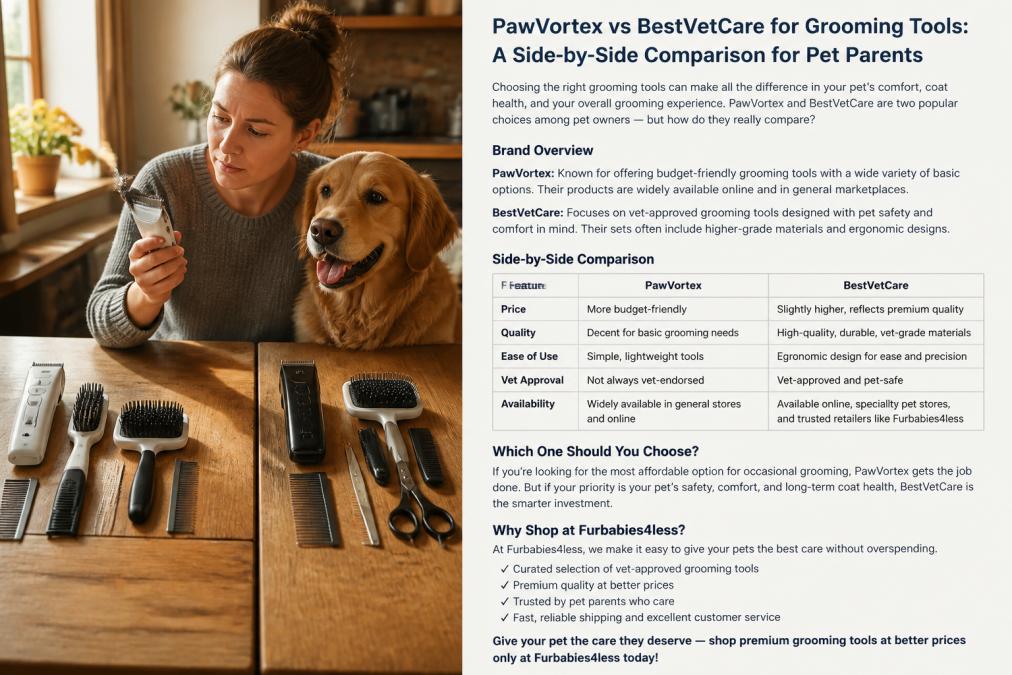
| Criteria | PawVortex | BestVetCare | Furbabies4less |
|---|---|---|---|
| Category focus | General pet supplies | Pet pharmacy and wellness | Vet-informed grooming and wellness |
| Price positioning | Mid-range, frequent promos | Varies by product type | Affordable premium |
| Build materials | Mixed by product line | Mixed by product line | Coat-safe, pet-first designs |
| Ease of use | Standard retail listings | Standard retail listings | Stress-reduction focused |
| Vet input | Not clearly stated | Pharmacy-oriented | Vet-informed selections |
| Rescue support | Not stated | Not stated | Portion of every sale |
Price and Value: What You Actually Pay For
Price alone rarely tells you which grooming tool is the better buy. A cheaper slicker brush that pulls at tangles costs you more in stress and replacement than a slightly higher-priced tool your pet tolerates.
PawVortex generally competes on volume and promotions, which suits buyers stocking up on basics. BestVetCare prices around its pharmacy identity, so grooming items sit alongside medications rather than being the main event. Neither approach is wrong, but both mean grooming tools get less curation.
What matters more is cost per use. A dematting tool that survives a full shedding season and keeps its stainless steel blades aligned is cheaper over a year than three budget replacements. Factor in whether the tool suits your pet's coat texture before you compare price tags at all.
Build Quality and Coat-Safe Materials
Build quality determines whether a grooming tool helps or hurts your pet. The details that matter most are blade material, edge finishing, and whether the tool snags the undercoat instead of gliding through it.
Start with the metal. Stainless steel blades on clippers and shears hold an edge longer and resist rust, but not all stainless is equal. Look for grades described as hardened or surgical-grade; softer alloys dull quickly and start pulling hair instead of cutting it, which is what turns a routine trim into a wrestling match. Ceramic blades run cooler and stay sharp, but they chip if dropped, so they suit careful owners more than chaotic households.
On brushes, the bristle tip is the whole story. Rounded or polished tips glide over skin; cut-wire ends scratch it. Run a fingertip across the bristles before you buy, if you feel a prickle, your pet will feel it harder. For pets prone to matting, a dematting tool with guarded teeth removes tangles without slicing the coat, and the guard is what separates a safe tool from a blade rake that can cut skin.
Coat type should drive the material choice, not the other way around. A quick compatibility map:
| Coat type | Best tool materials | Avoid |
|---|---|---|
| Double coat (Husky, Shepherd) | Stainless deshedding rake, undercoat rake | Slicker brushes alone; they skim the topcoat |
| Curly or wool (Poodle, Doodle) | Stainless slicker with long pins, guarded dematting tool | Short-pin brushes that miss the underlayer |
| Wire-haired (Terrier, Schnauzer) | Stripping knife, medium-firm slicker | Soft bristle brushes that flatten the coat |
| Short, smooth (Beagle, Boxer) | Rubber curry, soft bristle brush | Deshedding rakes, which can irritate skin |
| Long, silky (Yorkie, Maltese) | Wide-tooth comb, pin brush with coated tips | Fine-tooth combs that snap the hair |
PawVortex and BestVetCare both carry a mix of budget and mid-tier construction, and quality varies by individual product rather than by retailer. That inconsistency is the real problem: you can't assume a store's whole grooming line is coat-safe just because one item is. Check the material spec on each listing rather than trusting the brand banner.
Hypoallergenic and pet-safe materials matter more for pets with skin sensitivities or dander issues. This is where most comparison guides stop, and it's a gap worth naming: the materials in a grooming tool touch your pet's skin for minutes at a time, every session, for years. Non-toxic coatings, BPA-free plastic handles, and finishes free of heavy-metal residues are the details that separate a tool built for animal contact from one built for a shelf. When a listing doesn't specify materials or blade finishing, treat that as a gap, not a neutral, a seller who can't tell you what's in the tool usually can't tell you what's on it either.
Ease of Use and Ergonomic Design
Ergonomic design decides whether you finish a grooming session or quit halfway through. Most guides treat this as a pet-only concern, but the human side of grooming is where sessions actually break down. If your hand cramps twenty minutes in, the pet pays for it, you rush, you pull, and the next session starts with a flinch.
Start with grip. An ergonomic handle with a non-slip, rubberized grip reduces hand fatigue during long sessions, and a handle sized to your palm matters more than most buyers expect. A too-thick handle forces a pinch grip that strains the thumb; a too-thin one makes you clench. Test the fit the way you'd test a kitchen knife, if your fingers wrap comfortably with a little room, it's right.
Weight distribution is the second lever. A lightweight tool you can control with one hand works better on wiggly pets than a heavier unit that tires your wrist. But balance matters as much as total weight: a clipper that's heavy at the blade end pulls your wrist forward, while a well-balanced unit sits in your hand without fighting you. For owners who groom multiple pets or long-coated breeds, this is the difference between a fifteen-minute session and a forty-minute one.
Noise is the other half of ease of use, and it's a pet-side factor that's really an owner-side one. Many pets tolerate brushing fine and panic at clippers, because vibration and sound feel threatening up close. A low-noise trimmer changes that equation for anxious animals. Look for decibel ratings when a listing provides them; a quieter motor usually means less vibration, which is what actually spooks most pets.

Cordless versus corded is a real trade-off, not a clear winner. Cordless clippers let you maneuver around paws and faces without dragging a cord, which matters for nervous animals you can't reposition easily. Corded units run stronger and never die mid-session, which matters for thick coats that stall a weak motor. If you groom a resistant cat or a nervous rescue dog, prioritize quiet operation and light weight over cutting power you may not need.
A few owner-side habits cut fatigue regardless of the tool:
- Switch hands or rotate your grip every few minutes to spread the load
- Groom at a height where your elbow stays near 90 degrees, not bent up or reaching down
- Take a break when your grip starts to feel tight, before your hand shakes
- Keep the tool's blade or bristles clean; a clogged tool makes you press harder
If you groom a resistant cat or a nervous rescue dog, the tool that wins is the one you can hold comfortably for the full session. Ergonomic fit isn't a luxury feature; it's what keeps you steady enough to be gentle.
Vet Approval and Safety Standards
Vet approval isn't a single certification you can check off; it's a pattern of design choices that reduce injury risk. The tools that earn professional trust share specific safety features.
A safety guard on nail clippers prevents overcutting for beginners and wiggly pets. An LED light that illuminates the quick helps you avoid the painful mistake of cutting into the blood line, which is the single most common at-home grooming injury (avma.org). Rounded blade tips protect hard-to-reach areas like paw pads and the face.
PawVortex and BestVetCare both list safety features on select products, but neither retailer frames grooming tools around injury prevention as a category philosophy. That distinction matters if your pet has dark nails, thin skin, or a history of grooming-related fear.
If you're unsure whether a tool is appropriate for your pet's coat or condition, ask your veterinarian before using it. A quick question beats a groomer visit to treat a nick.
Availability, Shipping, and Returns
Availability shapes the buying decision more than most people admit. A tool you can't get this week doesn't help a pet already matting.
PawVortex and BestVetCare both operate as online retailers with standard shipping windows and return policies tied to their general merchandise terms. Neither specializes in fast fulfillment for grooming emergencies, so plan ahead if your pet's coat is already tangling.
Returns are where grooming purchases get tricky. Many retailers restrict returns on hygienic items once they've touched an animal, which is reasonable but leaves you holding a tool your pet rejects. Read the return window before ordering anything your pet might refuse.
For rescue pets with anxiety, the safer path is buying from a seller whose return terms are clear and who curates tools specifically for sensitive animals.
How to Groom a Resistant Cat With the Right Tools
Grooming a resistant cat succeeds through short, low-stress sessions and the right tool, not through force. Cats read restraint as threat, so the goal is making each session end before your cat decides it's a fight.
Start with a gentle brush and one or two strokes, then stop and reward. Build to longer sessions over weeks. For matting, use a dematting tool on small sections rather than tugging at tangles, which teaches your cat that grooming hurts.
Keep the environment quiet. A low-noise trimmer or a steam brush that softens the coat before brushing reduces the pulling sensation cats hate most. Never chase a cat to finish a session; end on a calm note and try again tomorrow.

- Work in 2-3 minute sessions, twice a week
- Brush in the direction of the coat, never against it
- Stop immediately at the first sign of agitation
- Pair every session with a treat or play
Best Grooming Tools for Long-Haired Pets
Long-haired pets need tools built for undercoat management, not just surface brushing. The right combination prevents matting before it starts and keeps the coat tangle-free between professional visits.
A slicker brush handles daily detangling on longer coats. A dematting tool breaks up existing tangles without cutting them out. For double-coated breeds, a deshedding tool removes loose undercoat and controls shedding before it lands on your furniture.
Drying matters as much as brushing for long coats. A pet dryer with adjustable temperature settings dries thick coats evenly and prevents the damp, matted patches that form when long fur air-dries (petmd.com). Hypoallergenic coat conditioning after bathing keeps the hair manageable and reduces dander.
For most long-haired pets, a realistic grooming routine looks like this:
- Daily: 2-3 minutes with a slicker brush
- Weekly: deshedding pass and a check for mats behind the ears and under the legs
- Monthly: bath, condition, and full dry
- As needed: nail trim with a clipper that has a safety guard and LED light
If your pet's coat is already matting despite routine brushing, the tool is usually the problem, not your technique.
Grooming a resistant pet or maintaining a long coat gets easier when the tools match the animal, and that's where Furbabies4less built its catalog. Every product is vet-informed and chosen with the same care that helped our own rescue dog, Oz, recover, from the 3-in-1 Gentle Steam Brush that softens tangles before brushing to the CalmFlow Pet Dryer built for noise-sensitive pets. A portion of every sale supports animal rescues, so your grooming kit does double duty. Shop Furbabies4less and give your pet a calmer grooming routine.

Frequently Asked Questions
What are the essential grooming tools every pet owner needs?
At minimum you need a brush matched to your pet's coat type, a pair of nail clippers with a safety guard or LED quick light, a low-noise trimmer for face, paws, and sanitary areas, and a pet-safe dryer if your pet has a thick or long coat. For long-haired pets, add a dematting tool and a stainless steel comb. Furbabies4less carries a 3-in-1 gentle steam brush at $18.99 and SafeGlow nail clippers at $27.99 that cover the basics without a salon-level spend.
How do I groom a resistant cat without getting scratched?
Start with the quietest tool you own and work in 2 to 3 minute sessions, stopping before your cat gets agitated. A low-noise trimmer like the Furbabies4less option at $24.99 avoids the vibration that triggers most feline panic. Wrap your cat loosely in a towel with one paw out at a time, and reward with a treat after every paw. Never chase a cat to finish a groom; you will lose trust and make the next session harder.
Are professional-grade grooming tools worth the investment for home use?
Only if your pet has a coat that needs frequent maintenance or mats easily. A $25 to $65 tool that lasts several years usually costs less than three salon visits. For short-coated pets that need occasional brushing, a $19 steam brush handles most of the work. Match the tool to your pet's coat texture and grooming frequency rather than buying the most expensive option on the shelf.
What should I look for when buying grooming brushes and clippers?
Check four things: blade material (stainless steel holds an edge and resists rust), noise level (under 60 decibels for anxious pets), handle grip (non-slip and sized to your hand), and safety features like rounded blade tips or an LED quick light. For long-haired breeds, make sure the brush reaches the undercoat, not just the top layer. A slicker brush alone will not prevent matting on a double-coated dog.
How often should I groom my pet to maintain coat health?
Short-haired dogs and cats need brushing once or twice a week. Long-haired breeds need daily brushing to prevent matting and tangles. Nails should be trimmed every 3 to 4 weeks, and baths every 4 to 8 weeks depending on activity level and skin condition. Anxious or senior pets often do better with shorter, more frequent sessions. Consistent grooming frequency matters more than session length for coat health and dander reduction.
