

How to Introduce a New Rescue Dog to Resident Cats
Quick Summary
The safest way to handle how to introduce a new rescue dog to resident cats is to go slowly, in stages. Start with scent swapping and separate spaces, then move to barrier visits, short leashed meetings, and supervised contact. Advance only when both animals stay calm, and keep a cat-only retreat available throughout.
- Let the rescue dog decompress for several days before any face-to-face contact.
- Swap bedding scents and feed both pets on opposite sides of a closed door.
- Keep leashed meetings to two to five minutes, then separate before anything escalates.
- Let the cat choose the distance; never carry or hold it toward the dog.
- Limit unsupervised time to after reliable cues and no sustained chasing.
Table of Contents
- Why Rescue Dogs and Resident Cats Need a Slower Introduction
- Preparing Your Home Before the Dog Comes Home
- Step-by-Step: Introducing a Rescue Dog to Your Cats
- How Long to Introduce a Dog to a Cat
- Using Baby Gates for Dog and Cat Introductions
- Signs a Cat Is Stressed by a Dog
- What to Do If a Dog Chases a Cat
- Setting Up Your Cats' Calm Space With the Right Gear
- Frequently Asked Questions
Why Rescue Dogs and Resident Cats Need a Slower Introduction
Last Updated: October 29, 2026
Bringing a rescue dog home is exciting, but the first week can be tense for everyone. Many rescue dogs arrive stressed, unsure, and still adjusting to a new home. Resident cats have their own territory and routines, and a sudden meeting can leave both animals on edge. Learning how to introduce a new rescue dog to resident cats the right way protects both pets and sets up a calmer home.
Think of it as a process, not a single event. The goal is not for the animals to become friends overnight. The goal is for each pet to feel safe enough that calm behavior becomes the easy choice.
- Rescue dogs may be decompressing from shelter stress
- Cats often need escape routes and high places to feel secure
- Short, controlled sessions can help keep introductions manageable
Watch out:
Preparing Your Home Before the Dog Comes Home
Set up the house before the dog walks in the door. Give your cats a safe room they can retreat to, such as a bedroom with a closed door, litter box, food, water, and a bed. Add a cat tree or high shelf so cats can watch the dog from above without being cornered.
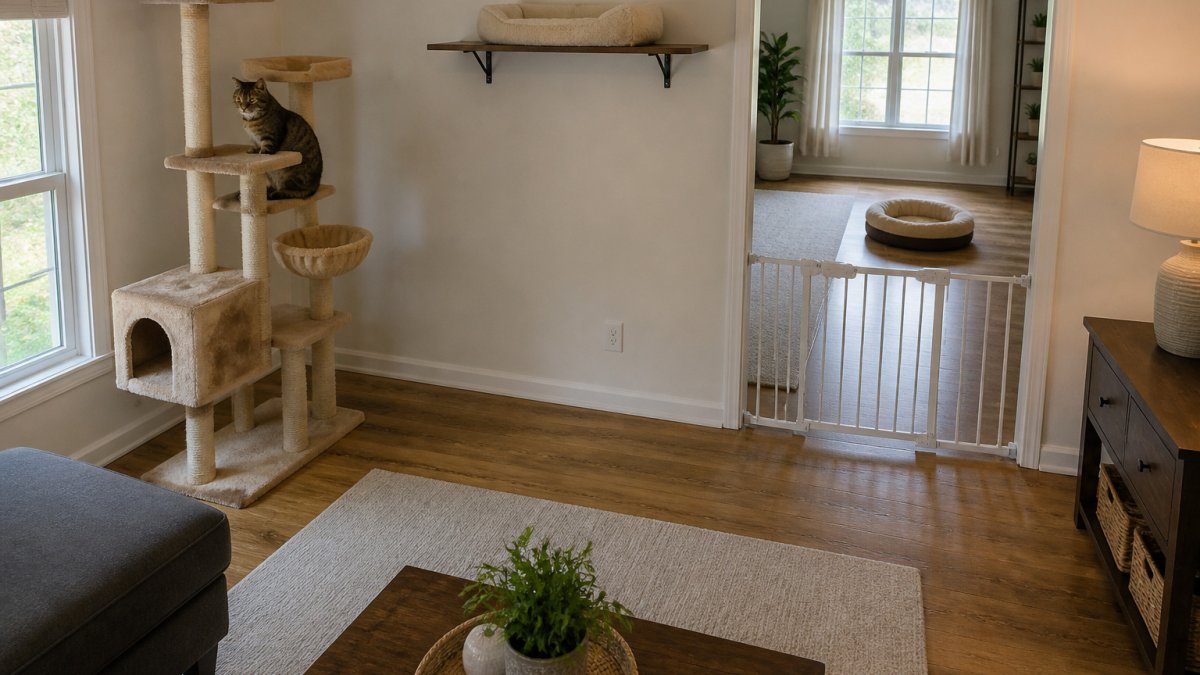
Plan the dog's space too. A calming dog bed in a quiet area gives your new rescue a settled spot that is its own.
- Set up a cat-only retreat with food, water, and a litter box
- Place elevated perches and escape routes around the home
- Put the dog's bed and crate in a low-traffic area
- Gather a leash, treats, and baby gates before arrival
Step-by-Step: Introducing a Rescue Dog to Your Cats
Move through the introduction in stages, and treat each stage as a gate rather than a calendar date. The next stage begins only when both animals are consistently relaxed in the current one across several short sessions.
Stage 0: Let the rescue dog decompress first
Use this window to observe. Note whether the dog fixates on the cats through a gate, whether it whines or scratches at the barrier, how quickly it recovers from excitement, and whether it responds to its name or a treat when aroused.
Stage 1: Scent exchange and separate spaces
Let the animals learn each other's smell before they see each other. Rub a clean cloth on the dog and leave it near the cats' area, then do the reverse with a cloth from the cats' bedding. Feed both pets on opposite sides of a closed door so food becomes a positive link. Keep sessions to a few minutes and end while both are still eating calmly.
Stage 2: Controlled visual contact with barriers
Once both animals eat calmly near the barrier, allow brief visual contact through a baby gate or a cracked door. Keep the dog leashed and reward calm behavior with high-value treats. Watch for the dog's ability to look at the cat and then disengage when you say its name or offer a treat.
Stage 3: Supervised, leashed, face-to-face meetings
- Keep the dog on a loose leash held by one adult, with a second adult watching the cats.
- Keep the first sessions to two to five minutes, then separate before anything escalates.
- Let the cat choose the distance. Do not carry the cat toward the dog or hold it in place.
- Reward the dog for looking at the cat and then looking back at you, and reward the cat with treats or praise for staying calm.
- End every session on a calm note, even if that means cutting it short after one minute.
Stage 4: Supervised off-leash contact with escape routes
Only move here when the dog has ignored or calmly acknowledged the cats across multiple leashed sessions and the cats are moving through the room rather than hiding. Keep the dog dragline-free but supervised, keep the cats' escape routes open, and stay ready to separate. Continue rewarding calm behavior and keep sessions short.
Stage 5: Gradual unsupervised time
Full unsupervised access is the last step, not the first. Even then, separate the animals when you leave the house and at feeding time, and keep the cats' safe room available permanently.
Anxiety Relief Lick Mat for Dogs – Calm Stress, Fear & Hyperactivity →
How Long to Introduce a Dog to a Cat
There is no fixed timeline, and any guide that promises one is guessing. What you can do is replace the calendar with decision points. Move forward when the animals show you specific signs, and pause when they show you others.
A realistic staged timeline for a rescue dog
Here is one possible staged timeline:
- Days 1 to 3: The dog decompresses in its own space. No face-to-face contact. Scent exchange through a closed door only. The cats keep their normal routine and safe room.
- Days 3 to 7: Barrier sessions begin if the dog is eating, sleeping, and settling. Brief visual contact through a gate, a few minutes at a time.
- Weeks 1 to 3: Short leashed meetings in a neutral room, two or three per day, each a few minutes long. Progress depends on the dog's ability to disengage and the cats' willingness to move through the room.
- Weeks 3 to 8: Supervised contact with escape routes, gradually lengthening sessions as both species stay calm.
- Two months and beyond: Limited unsupervised time only after reliable cues and a sustained absence of chasing.
Signs you can move to the next stage
- The dog looks at the cat and then disengages when called or offered a treat.
- The cats approach the barrier voluntarily rather than hiding.
- Both animals eat calmly near the barrier.
- The dog's body is loose, not stiff, and its tail is at a normal height rather than flagged high and rigid.
- The cats move through the shared space at a normal pace rather than slinking or freezing.
Signs you should pause or step back
- The dog fixates, lunges, barks, or scratches at the barrier and cannot be redirected.
- A cat hides for most of the day, stops eating, or avoids the litter box.
- Either animal shows stress signals that persist after the session ends.
- A chase or scuffle occurs. Separate, return to an earlier stage, and add distance and barriers.
When to bring in professional help
If the dog has injured or attempted to injure a cat, if a cat is showing persistent stress-related illness, or if weeks of staged work produce no progress, consult a veterinarian or a qualified behavior professional. In some cases, permanent separation with a managed, gate-based household is the safest and most humane outcome, and that is a legitimate result rather than a failure.
There is no fixed timeline, but the article lays out a staged schedule and the signs that tell you when to move on or pause.
| Phase | Timing | What to look for |
|---|---|---|
| Decompression | Days 1 to 3 | No face-to-face contact; scent exchange through a closed door |
| Barrier sessions | Days 3 to 7 | Brief visual contact through a gate, a few minutes at a time |
| Short leashed meetings | Weeks 1 to 3 | Two or three sessions per day, each a few minutes long |
| Supervised contact | Weeks 3 to 8 | Escape routes open; sessions lengthen as both stay calm |
| Limited unsupervised time | Two months and beyond | Only after reliable cues and no sustained chasing |
Using Baby Gates for Dog and Cat Introductions
Baby gates let cats and dogs see and smell each other while keeping physical contact controlled. Choose a gate that a cat can jump over or squeeze past, so the cat always has an escape route. Keep the dog leashed on the other side during early sessions.
Signs a Cat Is Stressed by a Dog
Watch for signs that a cat needs a break:
- Flattened ears or a puffed tail
- Hissing, growling, or swatting
- Hiding for long periods or refusing food
- Frequent grooming or sudden litter box changes
What to Do If a Dog Chases a Cat
Interrupt the chase calmly, using a leash or a firm "leave it" cue, then redirect the dog to a toy or treat. Never punish the dog for being excited, since that can increase anxiety. Return to an earlier stage of the introduction and add more distance.
Setting Up Your Cats' Calm Space With the Right Gear
Add a calming dog bed or lick mat in the dog's area.


Frequently Asked Questions
How long does it take for a rescue dog and resident cats to get along?
There is no fixed timeline for a rescue dog and resident cats to get along. Introductions can take time, and the animals' responses may vary.
How do I know if my cat is stressed by the new dog?
Watch for changes in your cat's behavior, such as hiding, flattened ears, a puffed or lashing tail, hissing, refusing food, or changes in litter box habits. If you are concerned, consult a veterinarian.
What should I do if my dog chases or fixates on my cat?
Stop the session calmly and separate the animals before the chase builds. Use a leash, a baby gate, or a crate to manage the dog, and reward any moment of calm attention with high-value treats. Go back to a earlier step where the dog can see the cat at a distance without reacting. Persistent fixation or chasing that does not improve with management is worth discussing with a veterinarian or a certified trainer.
Can a rescue dog and a cat be left alone together?
Not until you have clear evidence they coexist calmly while you are present. Leave them alone together only after weeks of relaxed behavior, and even then keep the cat's escape routes open and the dog crated or in a separate room when you cannot supervise. Never assume a calm moment means the relationship is settled.
Getting the introduction right takes patience, and the right supplies make it easier. At Furbabies4less, we build our calming products around the stress that rescue pets and their families face. Start slow, reward calm behavior, and let each pet set the pace. With steady progress, your rescue dog and resident cats can share a home in peace.

