

Best Premium Cat Supplies for Digestion: 2026 Guide
Table of Contents
- Why Your Cat's Digestion Needs More Than Just Food
- Quick Comparison: Best Premium Cat Supplies for Digestion
- Best Cat Food for Sensitive Stomach: What to Look For
- Probiotics for Cats with Digestive Issues: Do They Actually Help?
- Slow Feeder Bowls for Cats: Slowing Down Mealtime for Better Digestion
- Hydration Support: Water Fountains and Digestive Motility
- Age-Specific Digestive Needs and Environmental Stressors
- Common Allergens and Ingredients to Avoid
- Frequently Asked Questions
Last Updated: September 18, 2026
Why Your Cat's Digestion Needs More Than Just Food
Digestive upset in cats rarely traces to a single cause. It builds from fast eating, low moisture intake, stress, and ingredients the gut can't process well. That's why best premium cat supplies for digestion go far beyond a bag of kibble. At Furbabies4less, we've watched rescue cats with sensitive systems recover once their whole feeding setup changed, not just their food.
Quick Comparison: Best Premium Cat Supplies for Digestion
| Supply Category | What It Supports | Best For | Typical Price |
|---|---|---|---|
| Slow feeder bowls | Eating pace, less gulped air | Fast eaters, bloating | $19.99-$25.99 |
| Water fountains | Hydration, motility | Cats that avoid still water | $27.00 |
| Probiotic chews | Gut flora balance | Loose stools, diet changes | $24.99-$36.61 |
| Lick mats and balls | Calm feeding, enrichment | Anxious eaters, multi-pet homes | $3.74-$21.28 |
Each category solves a different part of the same puzzle. Most cats need two or three working together.

Best Cat Food for Sensitive Stomach: What to Look For
The best cat food for a sensitive stomach is built around a single animal protein, limited ingredients, and high moisture. Cats are obligate carnivores, so their digestive tract is designed for animal protein, not fillers.
Look for these markers on any label:
- One named animal protein listed first
- No artificial colors, flavors, or preservatives
- Limited ingredient list, ideally under ten items
- Added fiber from pumpkin or similar gentle sources
Limited Ingredient Diets and Novel Proteins
A limited ingredient diet removes the long list of potential triggers that make food sensitivities hard to pin down. Novel proteins like venison, duck, or rabbit work well because a cat's immune system hasn't seen them before.
Wet vs. Dry Food: Moisture Content and Digestibility
Wet food carries far more moisture than kibble, and that moisture supports digestive motility and nutrient absorption. Cats evolved to get most of their water from prey, so a dry-only diet often leaves them mildly dehydrated.
Probiotics for Cats with Digestive Issues: Do They Actually Help?
Probiotics for cats with digestive issues can genuinely help, but the evidence is strain-specific, not category-wide. The word "probiotic" on a label tells you almost nothing. What matters is which organism, at what dose, in what format, and whether the product also feeds that organism so it survives the trip through the stomach.
Which Strains Actually Have a Track Record in Cats
The two genera most studied in small-animal gastroenterology are Lactobacillus and Bifidobacterium, along with spore-forming Bacillus species. Strains that recur in feline and canine research include:
- Enterococcus faecium, often studied for acute diarrhea and stress-related loose stools
- Bifidobacterium animalis, supports stool consistency after diet transitions
- Lactobacillus acidophilus and Lactobacillus rhamnosus, commonly paired in multi-strain formulas
- Bacillus subtilis and Bacillus coagulans, spore formers that survive stomach acid better than many vegetative strains
CFU Counts, Colony Survival, and Why Format Matters
Probiotic potency is measured in colony-forming units, or CFUs. Most commercial feline and canine products land between 1 billion and 10 billion CFUs per serving, but that number only matters if the organisms are still alive at feeding. Heat, moisture, and time degrade live cultures, which is why format isn't cosmetic:
- Soft chews are convenient and palatable but often lose viability faster in warm storage.
- Powdered sachets mix into wet food and let you split doses, but they require refrigeration once opened for many brands.
- Capsules protect the culture until it reaches the gut, but many cats will not take a pill without a pill pocket or a compounded option.
- Spore-forming formulas trade some strain variety for stability, which matters if you buy in bulk or live in a humid climate.
Prebiotics, Digestive Enzymes, and Gut Microbiome Balance
Prebiotics are the fiber that feeds beneficial bacteria, common ones include fructooligosaccharides (FOS), mannan-oligosaccharides (MOS), inulin from chicory root, and psyllium husk. Digestive enzymes, protease, lipase, and amylase, help break down protein, fat, and carbohydrate so nutrients absorb properly. Together with probiotics, they form the three-part foundation of gut microbiome balance.

A Realistic Timeline for Results
Don't expect overnight results. Live cultures need consistent daily support to shift a microbiome. Most practitioners suggest giving a probiotic for at least three to four weeks before judging whether it's working, and continuing through any antibiotic course plus a week or two afterward. Progress is gradual: firmer stool, less gas, fewer hairballs, a calmer post-meal routine.
Slow Feeder Bowls for Cats: Slowing Down Mealtime for Better Digestion
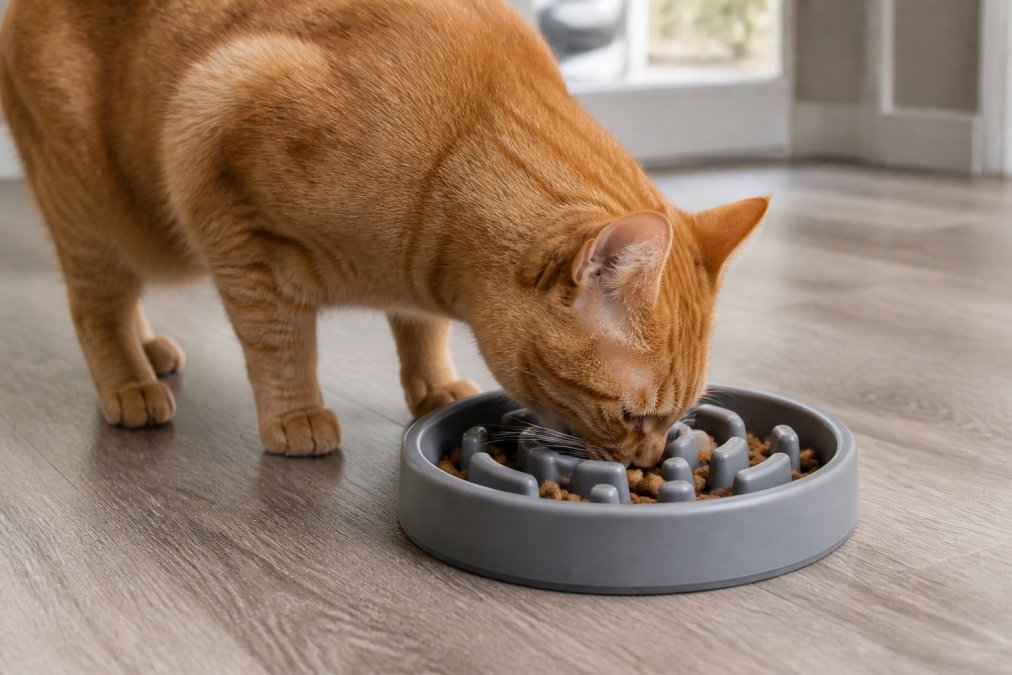
Slow feeder bowls for cats force a cat to work around ridges or channels to reach food, slowing eating and reducing swallowed air. Fast eating is one of the most overlooked causes of vomiting and bloating in cats.
Hydration Support: Water Fountains and Digestive Motility
Water fountains support digestive motility by encouraging cats to drink more throughout the day. Cats are drawn to moving water by instinct, and a static bowl often goes untouched.
Digestive Health Slow Feeder Bowl for →
Age-Specific Digestive Needs and Environmental Stressors
Most guides treat "the cat" as one animal. A kitten, a middle-aged indoor cat, and a fifteen-year-old senior have meaningfully different digestive physiology, and stress affects each one differently.
Kittens: Building a Gut From Scratch
A kitten's gastrointestinal tract is still maturing through roughly the first year. The microbiome is less diverse, the intestinal lining is more permeable, and the pancreas and liver aren't yet at adult output, so kittens are more vulnerable to sudden diet changes, parasites, and overfeeding. In practice:
- Protein density matters more than novelty. Growing kittens need highly digestible animal protein, not exotic proteins chosen for allergy reasons they probably do not have yet.
- Portion control beats free-feeding. Small, frequent meals, three to four a day up to about six months, match stomach capacity and reduce the bolting that leads to post-meal vomiting.
- Transitions should be slower than for adults. A seven-to-ten-day crossfade is a reasonable default; a kitten with a sensitive gut may need two weeks.
- Deworming and fecal checks are part of digestive care. Loose stool in a kitten is a veterinary question, not a food-shopping question.
Adults: Consistency Is the Whole Game
Once a cat reaches maturity, the digestive system rewards routine. The microbiome stabilizes, enzyme output is steady, and the biggest threats become abrupt change and chronic low-grade stress.
Adults do best on:
- A consistent primary diet, with treats and toppers kept to a small share of daily calories
- A fixed feeding schedule rather than grazing, which makes appetite changes visible
- Stable hydration, this is where a fountain earns its place, because adult cats on dry food are chronically under-hydrated relative to their evolutionary baseline
Seniors: Slower Motility, Thinner Margins
Cats are considered senior from around age eleven, though large breeds and cats with chronic conditions age faster. Typical digestive changes include:
- Reduced gastric motility, which shows up as constipation or alternating stool quality
- Lower digestive enzyme production, making high-fat or high-fiber diets harder to process
- Reduced thirst drive, compounding dehydration risk and stressing the kidneys
- Higher rates of chronic conditions, chronic kidney disease, hyperthyroidism, and inflammatory bowel disease all present with digestive signs
The Gut-Brain Connection: How Stress Becomes Diarrhea
- Moving to a new home
- Adding a new pet or a new baby
- Loud or unpredictable noise, construction, thunderstorms, household chaos
- Changes in litter box location, litter type, or cleaning routine
- Multi-cat tension, especially around food and water stations
- Boarding, travel, or a vet visit
Furbabies4less lick mats and enrichment plates give anxious cats a low-stress outlet that supports behavior and digestion. Licking is self-soothing, and spreading wet food across a textured mat slows eating while giving the cat a calm, solitary activity, which matters most in multi-pet homes where the food bowl is a source of tension.
Common Allergens and Ingredients to Avoid
The most common feline allergens are beef, dairy, fish, and chicken, plus artificial additives. Ingredient toxicity is separate: onion, garlic, chocolate, and xylitol are dangerous to cats in any amount.
Read labels for these triggers:
- Artificial colors and preservatives
- "Meat by-products" with no named source
- Added sugars or sweeteners
- Multiple proteins in one formula
Frequently Asked Questions
What is the best digestive supplement for cats?
The best digestive supplement for cats depends on the specific issue. For general gut support, probiotics containing Bacillus subtilis and Bifidobacterium help balance gut flora. Prebiotics like fructooligosaccharide (FOS) feed good bacteria, while digestive enzymes such as papain support nutrient breakdown. Look for veterinary-formulated options with clear ingredient lists. Always introduce supplements gradually and consult your vet before starting, especially if your cat takes medication or has a diagnosed condition.
What should I give my cat for digestion?
Start with the basics: a limited ingredient diet with animal protein your cat tolerates, plenty of fresh water, and slow feeder bowls for cats that gulp their food. If your cat has recurring issues like vomiting, diarrhea, or bloating, add a probiotic formulated for felines. Fiber content from pumpkin or psyllium can help with motility. Avoid sudden diet changes and introduce new foods over 7 to 10 days. If symptoms persist beyond a few days, see your veterinarian.
How can slow feeders improve cat digestion?
Slow feeder bowls for cats force your pet to work around ridges or puzzle channels to reach their food, slowing eating by up to 10 times. This reduces the amount of air swallowed, which lowers bloating and gas. Slower eating also gives digestive enzymes time to break down food properly, improving nutrient absorption. For cats that vomit after meals or eat too quickly, a slow feeder is one of the simplest and most effective changes you can make.
Are probiotics effective for feline digestive health?
Probiotics for cats with digestive issues can help restore gut microbiome balance after illness, antibiotics, or diet changes. Strains like Bacillus subtilis, Bifidobacterium, and Saccharomyces cerevisiae support healthy gut flora and can reduce gas, bloating, and loose stools. Results vary by cat and strain, so choose a veterinary-formulated product and give it daily for at least 2 to 4 weeks. Probiotics work best alongside a suitable diet and proper hydration, not as a standalone fix.
When should I consult a veterinarian about my cat's digestion?
See your veterinarian if your cat has vomiting or diarrhea lasting more than 24 to 48 hours, blood in stool, unexplained weight loss, persistent bloating, or refuses to eat for more than a day. These signs can point to food intolerance, inflammation, or more serious conditions. A vet can rule out underlying disease, recommend a limited ingredient diet, and advise on probiotics or digestive enzymes. Early intervention prevents minor digestive irritation from becoming a chronic problem.
