

Best Enrichment Feeders for Cats 2026
Table of Contents
- Why Enrichment Feeders Matter for Indoor Cats
- Cat Puzzle Feeder Benefits Explained
- Top Enrichment Feeders for Cats This Year
- How to Introduce a Slow Feeder to a Cat
- Cat Enrichment for Indoor Cats: Beyond Food Puzzles
- Safety Tips and Maintenance for Puzzle Feeders
- Choosing the Right Feeder for Your Cat's Needs
- Conclusion
- Frequently Asked Questions
Last Updated: September 18, 2026
Why Enrichment Feeders Matter for Indoor Cats
Indoor cats face a challenge most pet parents don't fully appreciate: boredom. Without the mental and physical stimulation that outdoor hunting provides, indoor cats often develop behavioral problems, anxiety, and weight issues. This is where enrichment feeders for cats become essential.
Unlike traditional bowls that deliver meals in seconds, enrichment feeders for cats slow down eating, engage their natural hunting instincts, and provide the cognitive stimulation they need to stay healthy and calm. The difference is measurable. Cats that use these tools show reduced destructive behavior, better digestion, and lower stress levels.
At Furbabies4less, we've seen firsthand how the right enrichment tool transforms a bored, anxious cat into a focused, satisfied one. Our rescue philosophy centers on understanding what pets actually need, not just what's convenient for us. Enrichment feeders sit at the intersection of wellness and behavior, they're not luxury items, they're behavioral medicine.
Cat Puzzle Feeder Benefits Explained
A cat puzzle feeder isn't just a slow feeder. It's a problem-solving activity that mimics the mental work cats do in the wild when hunting prey. When a cat must work for their food, several things happen simultaneously: their brain activates, stress hormones drop, and their natural prey drive gets channeled into something productive.

The benefits are specific and measurable. Cats using puzzle feeders experience improved digestive health because they eat more slowly, reducing gulping and bloating. Their mental health improves through cognitive stimulation, the puzzle requires focus and strategy. For multi-cat households, puzzle feeders can also reduce competition and aggression at mealtime, as each cat works at their own pace.
Behavioral modification is another key benefit. A cat that's mentally engaged is a cat that's less likely to knock things off counters, scratch furniture, or display stress-related behaviors. The foraging simulation satisfies an instinctual need that regular feeding never addresses.
Top Enrichment Feeders for Cats This Year
When selecting enrichment feeders for cats, you're choosing between different mechanisms of engagement. Some use 3D shapes that require rotation and pawing. Others use maze designs that slow eating through ridges and channels. The best choice depends on your cat's age, energy level, and specific needs.
Interactive Lick Ball: 3D Mental Stimulation for Multi-Pet Homes
The Interactive Lick Ball stands out because it works for both cats and dogs, a genuine advantage in multi-pet households. Unlike flat lick mats, the 3D ball design forces pets to rotate, nose, and paw the toy to access treats, creating deeper mental engagement.
Fill it with peanut butter, yogurt, or wet food and watch your cat work. The rotating ball design keeps the brain engaged longer than flat surfaces because the challenge changes with each interaction. Your cat can't fall into a repetitive pattern, they must problem-solve continuously.
This tool excels for anxious cats during alone time or travel. The licking action releases endorphins that naturally calm stress responses. It also supports oral health through the textured surface, which helps clean teeth and massage gums.
Price: $3.74 at Furbabies4less
Best for: Multi-pet homes, anxious cats, fast eaters needing mealtime slowed down, post-surgery recovery requiring calm, low-activity enrichment
What works: Non-toxic, pet-safe materials. Dishwasher safe and fully reusable. Works for all breeds and sizes. Available in orange and blue.
Where it falls short: The ball shape works best for cats that enjoy interactive play. Some older or less active cats may prefer flat mats.
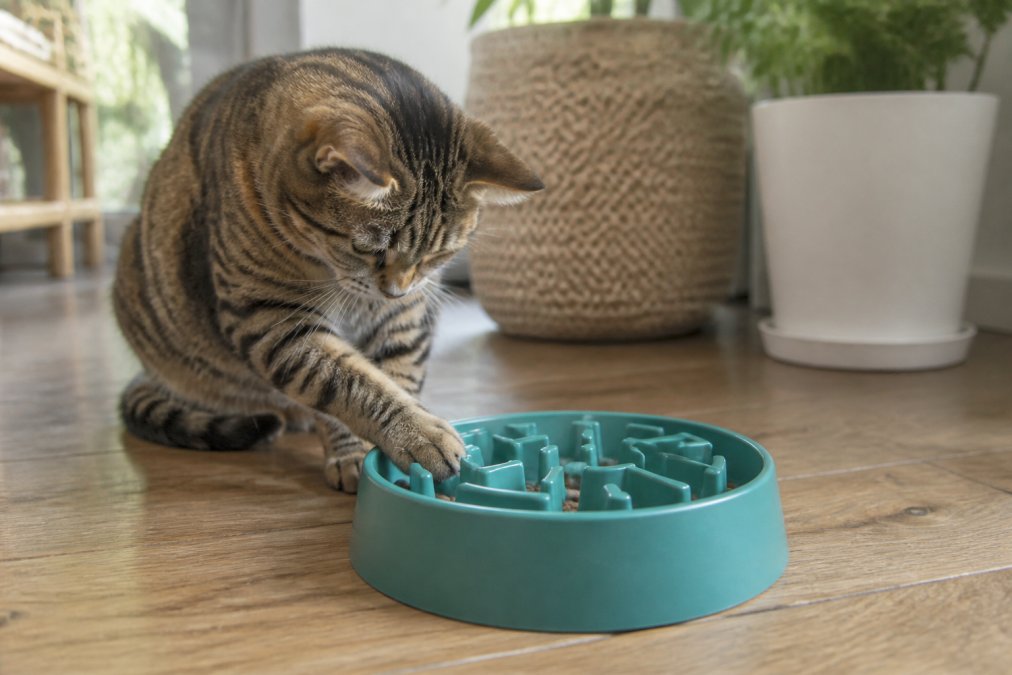
Smart Slow Puzzle Feeder Bowl for Cats: Maze Design for Digestive Control
The Smart Slow Puzzle Feeder Bowl is purpose-built for cats that inhale their food. The puzzle maze design forces cats to navigate ridges and channels to reach kibble, slowing eating by up to 10 times compared to standard bowls.
This directly addresses digestive issues. Slower eating means less gulped air, better nutrient absorption, and reduced vomiting. The non-slip base keeps the bowl firmly in place even for enthusiastic eaters, and the dishwasher-safe construction makes daily use practical.
Interactive Lick Ball for Dogs & Cats →
For indoor cats specifically, this bowl doubles as mental enrichment. Each meal becomes a problem-solving activity rather than a 30-second consumption event. Cats that need slower, more controlled feeding benefit most, particularly those with a history of bloating or digestive sensitivity.
Price: $25.99 at Furbabies4less
Best for: Cats that eat too fast, those needing digestive control, pets requiring mental stimulation between activities, kittens learning healthy eating habits
What works: Puzzle maze design that naturally slows eating. Pet-safe, non-toxic materials suitable for cats of all sizes.
Enrichment Licking Plate: Foraging Simulation and Anxiety Relief
The Enrichment Licking Plate operates on a different principle, suction-based engagement. Stick it to any smooth surface (wall, floor, or tile), spread on wet food or treats, and let your cat work for every lick.
Price: $21.28 at Furbabies4less
How to Introduce a Slow Feeder to a Cat
For older cats or those with mobility issues, choose feeders with larger openings and less complex mazes. The goal is mental engagement, not physical struggle. Age-appropriate feeder selection matters significantly.
Cat Enrichment for Indoor Cats: Beyond Food Puzzles
Food-based enrichment is powerful, but it's only part of the picture. Indoor cats need sensory-specific enrichment that addresses different aspects of their psychology: visual stimulation, tactile feedback, hunting simulation, and environmental variety.
Safety Tips and Maintenance for Puzzle Feeders
Puzzle feeders require specific care to remain safe and effective. Food residue left in grooves or crevices can harbor bacteria, so daily rinsing is essential. Most enrichment feeders for cats are dishwasher safe, which simplifies maintenance.
Choosing the Right Feeder for Your Cat's Needs
The right enrichment feeder depends on your cat's specific situation. Age-appropriate feeder selection is critical. Kittens benefit from simpler designs that don't frustrate them as they learn. Senior cats need larger openings and less complex mazes to accommodate reduced mobility and vision.
Conclusion
Enrichment feeders for cats aren't optional accessories, they're essential tools for behavioral health and digestive wellness. Whether you choose a 3D ball, a maze bowl, or a licking plate, you're investing in your cat's mental stimulation, anxiety relief, and natural foraging instincts.
| Feeder Type | Best For | Price | Key Benefit |
|---|---|---|---|
| Interactive Lick Ball | Multi-pet homes, anxious cats | $3.74 | 3D mental stimulation, works for cats and dogs |
| Smart Slow Puzzle Feeder Bowl | Fast eaters, digestive issues | $25.99 | Slows eating by 10x, prevents bloating |
| Enrichment Licking Plate | Anxiety relief, foraging simulation | $21.28 | Calming repetitive licking, sticks to any surface |
Frequently Asked Questions
What are the main benefits of using enrichment feeders for cats?
Enrichment feeders provide multiple benefits for indoor cats. They slow eating speed, which improves digestive health and prevents bloating and vomiting. They deliver cognitive stimulation that reduces boredom and destructive behavior, mimicking the natural foraging and hunting instincts cats use in the wild. Puzzle feeders also help with weight management by extending mealtime and increasing the effort required to access food. Regular mental stimulation through feeding puzzles supports overall behavioral health and can reduce stress-related issues like anxiety and excessive vocalization.
How do I introduce a slow feeder to my cat if they're used to regular bowls?
Start slowly by placing the puzzle feeder next to your cat's regular bowl for a few days so they become comfortable with it. Once they show interest, fill it with their favorite wet food or treats and let them explore at their own pace. Initially, the puzzle may be frustrating, so use high-value foods they're motivated to work for. Gradually increase the difficulty over time as they learn the mechanics. Some cats adapt within days; others may need a week or two. Be patient and avoid forcing them to use it exclusively right away. If your cat loses interest, try a different puzzle style that better matches their skill level.
Can enrichment feeders help prevent obesity in cats?
Yes, enrichment feeders are an effective tool for weight management. By slowing eating speed and extending mealtime, they help cats feel fuller faster while consuming the same portion size. The increased effort required to access food from a puzzle also burns additional calories during meals. For indoor cats with limited physical activity, this added mental and physical engagement during feeding can contribute to healthier weight maintenance. Combine puzzle feeders with portion control and regular play sessions for best results in managing your cat's weight.
What materials should I look for in a safe cat enrichment feeder?
Choose feeders made from non-toxic, food-grade materials like BPA-free silicone or durable plastic designed for pet use. Avoid materials that splinter, crack easily, or contain toxic dyes. Look for feeders that are dishwasher safe for easy cleaning and sanitation. Check that all components are securely attached with no small parts that could be ingested. Ensure the feeder has no sharp edges or rough surfaces that could injure your cat's mouth or paws. Quality enrichment feeders should be specifically designed for cats and tested for safety with pet use.
How often should I rotate my cat's puzzle feeders?
Rotate puzzle feeders every 1-2 weeks to maintain novelty and prevent boredom. Cats quickly adapt to familiar puzzles, so regular rotation keeps them mentally engaged and interested in mealtime enrichment. If you have multiple feeders, alternate between them to give your cat variety. You can also rotate the placement of the feeder in different rooms to add environmental novelty. Pay attention to your cat's interest level; if they lose engagement with a particular puzzle, it's time to switch to a different style or difficulty level.
